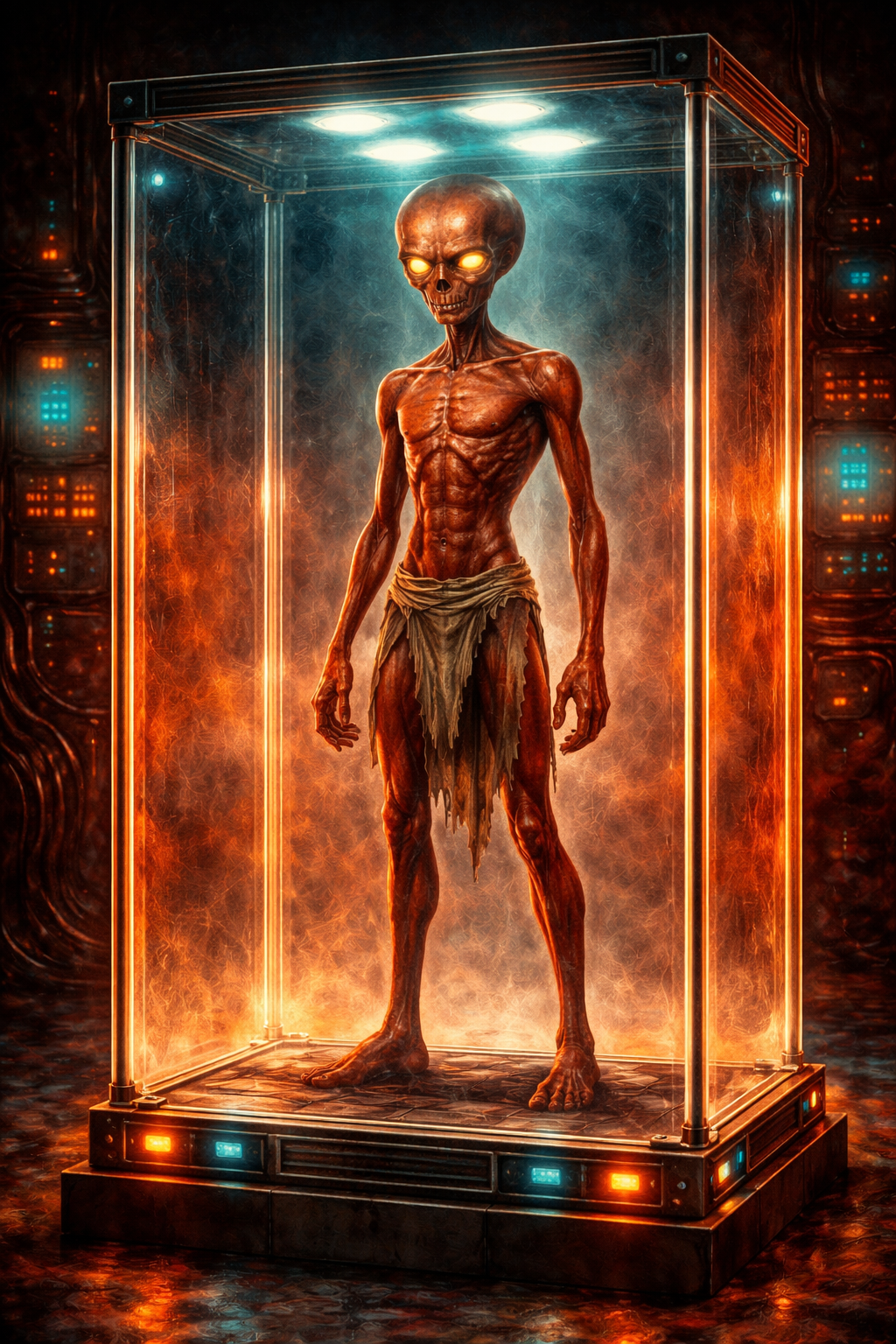
Martians
Martians are one of the oldest and most influential alien species concepts in modern culture. Unlike many later species pages that come mainly from UFO testimony, Martians grew out of a mix of real astronomy, mistaken telescope interpretations, speculative science, and fiction. Mars is a real rocky planet, the fourth from the Sun, with a thin atmosphere made mostly of carbon dioxide and two small moons, Phobos and Deimos. :contentReference[oaicite:0]{index=0}
Within this encyclopedia, Martians function as a major classic alien archetype page. They connect naturally to:
Overview
In different traditions, Martians may be described as:
- ancient planetary extraterrestrials
- survivors of a dying civilization
- humanoid or near-humanoid beings
- technologically advanced but declining societies
- hidden or extinct inhabitants of Mars
- symbolic “first aliens” in modern imagination
Martians matter because Mars became the single most important planet in early alien speculation. In the late 19th and early 20th centuries, many people thought Mars might host intelligent life, especially after astronomers claimed to see “canals” on its surface. :contentReference[oaicite:1]{index=1}
Mars as an origin point
Mars has always been a strong anchor for alien lore because it is nearby, visible, and Earth-like enough to inspire comparison. It is the fourth planet from the Sun, about 228 million km away on average, with a year of about 687 Earth days. :contentReference[oaicite:2]{index=2}
In alien lore, Mars often functions as:
- a nearby homeworld for intelligent life
- a dying or desert civilization
- a lost technological culture
- a bridge between astronomy and fiction
- a source of hidden bases or ancient ruins
Related:
The canals of Mars
This is the most important historical section on the page.
The modern Martian species idea was massively shaped by the canals of Mars controversy. In the late 19th century, observers reported long straight lines on Mars. Giovanni Schiaparelli’s observations were later popularized by Percival Lowell, who argued these were artificial canals built by intelligent Martians to move water across a dying world. That theory is now abandoned; the “canals” are understood to have been illusory. :contentReference[oaicite:3]{index=3}
Why this matters
This is one of the key origin stories of modern alien culture. Before Greys, before abduction lore, and before modern disclosure narratives, there were Martians.
The canal myth gave readers a full package:
- a real nearby planet
- a dying civilization
- advanced engineering
- a reason for contact or conflict
- a scientific-looking basis for speculation
Common portrayal in alien lore
Martians are portrayed in very different ways across different eras.
Canal-era Martians
These are often imagined as:
- intelligent engineers
- inhabitants of a drying planet
- builders of huge irrigation systems
- ancient but technologically advanced
Science-fiction Martians
These may appear as:
- invaders
- insectoid or tentacled beings
- frail cerebral species
- superior but decadent civilizations
UFO-era Martians
Later lore sometimes reimagines Martians as:
- hidden survivors
- secret allies or observers
- beings using underground bases
- extinct or relocated planetary civilizations
This makes Martians one of the most flexible pages in your taxonomy.
Physical description
There is no single standard Martian appearance.
Common depictions include:
- humanoid bodies
- frail, large-headed beings
- green or gray-skinned alien figures
- more human-like desert survivors
- symbolic “red planet” beings
This variation is part of the appeal. Martians are less a fixed witness-based species and more a historical umbrella category shaped by astronomy, fiction, and later UFO reinterpretation.
Martians and classic science fiction
Martians became one of the foundational alien species of modern fiction. Much of what later alien culture became was filtered through Mars first.
Common themes include:
- dying planetary worlds
- invasion from another planet
- superior alien intellect
- planetary engineering
- fear of technologically advanced outsiders
This gives your Martians page a unique role: it can connect not just to UFO lore, but also to the historical imagination of extraterrestrials.
Related:
Martians and UFO lore
Although Mars lost credibility as the most likely home of intelligent life as astronomy improved, Martians never fully disappeared from fringe traditions.
Later UFO and esoteric systems sometimes describe Martians as:
- ancient inhabitants of Mars
- survivors in underground habitats
- offshoots relocated to hidden bases
- linked to secret military or hidden-colony narratives
This makes the page useful for connecting to:
Martians and dying-world mythology
A major part of Martian lore is the idea that Mars is or was a dying world. This is partly rooted in older beliefs about canals and a fading civilization, and partly in the fact that Mars really does have a thin atmosphere and cold surface conditions today. :contentReference[oaicite:4]{index=4}
Why this matters
The dying-world motif is powerful because it gives Martians a tragic dimension:
- they are not just aliens
- they are survivors
- they represent loss, adaptation, and decline
- they mirror fears about Earth’s own future
Martians in outer-space taxonomy
Martians are essential to your encyclopedia because they cover the planet-origin civilization branch from a different angle than Venusians.
They work especially well with:
That gives your taxonomy stronger coverage of:
- nearby planets
- nearby stars
- classic contactee species
- fiction-to-ufology crossover species
Martians and hidden-base theories
Modern fringe lore sometimes attaches Martians to:
- hidden installations on Mars
- underground surviving populations
- secret human contact
- off-world colonies and retrieval programs
This is where the page can later support:
/aliens/lunar-martian-bases//places/global-hotspots/mars/comparisons/entities/martians-vs-venusians
Frequently asked questions
What are Martians?
Martians are extraterrestrial beings described in astronomy-inspired lore, classic science fiction, and later UFO mythology as inhabitants of Mars.
Did people really believe Mars had intelligent life?
Yes. In the late 19th and early 20th centuries, some astronomers and the public believed Mars might host intelligent beings, especially because of the supposed canals. :contentReference[oaicite:5]{index=5}
Are the canals of Mars real?
No. The canal theory was later rejected; the apparent lines were illusory, not artificial structures. :contentReference[oaicite:6]{index=6}
Is Mars a real place in astronomy?
Yes. Mars is the fourth planet from the Sun, with a thin carbon-dioxide atmosphere and two moons, Phobos and Deimos. :contentReference[oaicite:7]{index=7}
Are Martians scientifically proven?
No. Mars is real, but Martian civilization claims belong to speculative astronomy history, fiction, and UFO lore rather than established science. :contentReference[oaicite:8]{index=8}
Editorial note
This encyclopedia documents claims, source traditions, and interpretive frameworks found in astronomy-inspired alien lore, classic science fiction, and UFO mythology. Martians are best understood as one of the oldest and most influential alien-species concepts in modern culture.