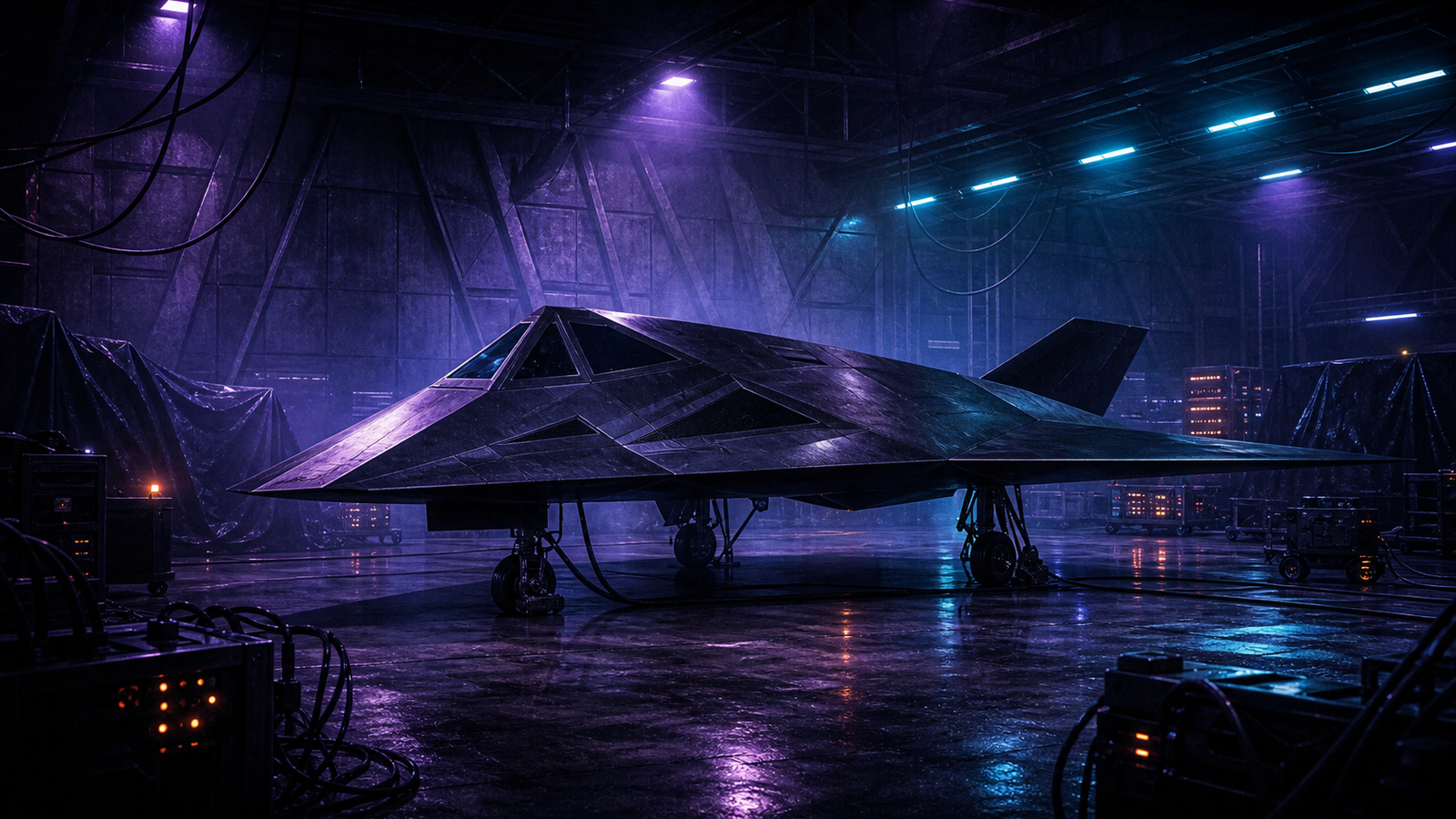
Have Blue Stealth Demonstrator Black Project
Have Blue mattered because it was the point where stealth stopped being a theory and became a machine.
That is the key.
Not a rumor. Not a sketch. Not a speculative study left buried in a vault.
A machine.
A faceted airframe. A desert test site. A program protected by deep secrecy. A design shaped by radar mathematics more than by normal aviation instinct. A pair of demonstrators so radical that even their survival in the air depended on digital correction.
That combination was always going to create something larger than an experimental aircraft. It created a turning point.
In black-project history, Have Blue became the proof that a combat aircraft did not need to overpower a defense network if it could instead slip through it with drastically reduced visibility.
That is why it matters. Have Blue made absence into strategy.
The first thing to understand
This is not only a stealth story.
It is a threshold story.
That matters.
Many black programs are remembered because they promised things. Have Blue is remembered because it proved something.
It proved that:
- radar invisibility could be engineered rather than merely imagined,
- a combat-relevant aircraft could be shaped around low observability,
- computers could keep an unstable stealth form flying,
- and a secret demonstrator could alter doctrine before the public even knew it existed.
That is what gives Have Blue its unusual weight. It is not only an aircraft. It is the gate between theory and operational doctrine.
Why the United States wanted something like Have Blue
Have Blue did not emerge from aesthetic experimentation. It emerged from a survivability crisis.
DARPA histories trace the program back to growing fear in the 1970s that advanced, networked air defenses were making conventional strike aircraft dangerously vulnerable. Vietnam had already shown how lethal radar-guided missile environments could become. The 1973 Arab-Israeli war deepened that lesson. To planners thinking about a future NATO-Warsaw Pact conflict, the problem was becoming intolerably clear: speed, altitude, and traditional penetration tactics might no longer be enough.
That matters because Have Blue was born from a brutally practical question: how do you keep an aircraft alive in a radar-dense battlespace?
The answer was radical. Stop treating detection as inevitable.
Why the program became so historically important
The deeper importance of Have Blue is that it marked a change in military imagination.
For decades, advanced aircraft had often been judged by:
- how fast they could go,
- how high they could climb,
- how hard they could turn,
- or how much payload they could carry.
Have Blue shifted the center of gravity.
Now the crucial question became: how little can the enemy see?
That is one of the great design revolutions in military aviation. Have Blue belongs to that revolution because it gave it airframe form.
The mathematical birth of the aircraft
One reason Have Blue feels so unusual even now is that it was born from mathematics before it was born from normal aerodynamic taste.
That matters because the aircraft’s outer form was not mainly trying to look elegant, fast, or conventionally efficient. It was trying to behave correctly under radar illumination.
DARPA and later stealth histories emphasize the importance of Lockheed’s Echo 1 modeling approach. Lockheed engineer Denys Overholser is repeatedly treated as one of the key enabling figures because Echo 1 gave designers a way to estimate radar return and therefore shape an aircraft around observability logic. The work is inseparable from the influence of Pyotr Ufimtsev, whose diffraction research gave stealth designers a conceptual basis for treating edges and surfaces as calculable scattering problems.
That is why Have Blue looks the way it does. It was built by radar logic first.
Why the faceted shape mattered so much
The faceted shape was not an artistic flourish. It was a computational necessity.
That matters because 1970s computing could not yet model the radar behavior of smoothly blended stealth forms with the same practicality later programs would achieve. Flat surfaces and sharp facets gave designers something they could calculate, arrange, and test. The result was an aircraft that seemed visually impossible by the standards of ordinary aviation aesthetics.
That is why later aircraft would look different. Have Blue belonged to the age when stealth had to be solved in planes.
It looked crude only if you judged it by aerodynamic elegance. It looked revolutionary if you judged it by radar behavior.
Why people called it the Hopeless Diamond
The nickname matters.
Hopeless Diamond captures the emotional truth of the program better than many formal descriptions.
That matters because the aircraft did in fact look absurd to many eyes:
- too angular,
- too unstable,
- too compromised,
- too strange to become the ancestor of a real warplane.
But black-project history often works like that. A machine first appears impossible precisely because it is answering a question the old design language never had to answer.
Have Blue looked like a bad airplane in the old grammar. It became a brilliant airplane in the new one.
The pole before the airplane
One of the most revealing things about Have Blue is that belief in it had to be built before flight.
That matters because the road to the demonstrator ran through radar testing and model evaluation before it ran through the sky. DARPA histories describe full-scale and one-third-scale model testing to determine which stealth approach actually met the agency’s low-observability criteria. In that sense, Have Blue had to win first as an electromagnetic object before it could justify existing as an aircraft.
That is the black-project logic at its most pure.
Before the airplane proved itself to pilots, it had to prove itself to radar.
Why Groom Lake mattered
Have Blue could almost only have happened at Groom Lake.
That matters because Groom Lake was not just a secret runway. It was a protected ecosystem for impossible aircraft.
A design like Have Blue needed:
- physical isolation,
- controlled airspace,
- protected logistics,
- minimized observation,
- and a culture already accustomed to projects whose public existence could not be acknowledged.
That is why Have Blue belongs so naturally to black-project mythology. It did not merely benefit from secrecy. It required secrecy.
A prototype meant to change how aircraft disappear could not be developed in a fully visible world.
Why the aircraft had to be digitally saved
Another reason Have Blue became legendary is that it was not a naturally friendly machine.
That matters because stealth geometry imposed real penalties. The aircraft’s shape reduced radar return, but that same design logic brought aerodynamic instability and handling burdens. Early stealth aircraft were not elegant in the traditional sense. They were bargains with physics. Fly-by-wire control was not ornamental. It was survival equipment.
This is one of the most important ways to understand Have Blue.
The aircraft did not announce the future simply by being stealthy. It announced the future by showing that computers could help make radically compromised but strategically superior airframes practical.
In that sense, Have Blue was not just stealth. It was stealth plus digital rescue.
Why Have Blue felt like a true black project
Some secret programs later become mythic because people exaggerate them.
Have Blue became mythic because the reality was already strong enough.
That matters because the program had everything the black-project imagination responds to:
- Skunk Works lineage,
- DARPA sponsorship,
- Groom Lake testing,
- impossible-looking geometry,
- a hidden strategic purpose,
- and a direct connection to a major transformation in warfighting.
It looked like the kind of project people imagine when they think about hidden aerospace development because it actually was that kind of project.
That is why it occupies such a rare position. It is one of the cases where the legend grows not from fabrication but from the extraordinary nature of the real thing.
The two demonstrators and why both mattered
Have Blue is often reduced to a single symbolic image, but the program was built around two demonstrators.
That matters because Have Blue was not a one-flight stunt. It was a validation campaign.
Retrospectives consistently describe two aircraft built for the program and flown out of Groom Lake. The first prototype made its initial flight in late 1977. The test effort was sufficiently promising that the stealth concept quickly moved from fragile experiment to procurement relevance.
This is one of the most important facts in the whole story.
Have Blue did not need a long public proving cycle. It only needed enough flight evidence to convince the classified system that the idea worked.
Why the crashes do not diminish the program
Both Have Blue demonstrators were eventually lost.
That fact should not be treated as a footnote. It should be treated as part of the meaning.
That matters because black-project breakthroughs often emerge from machines that are deeply compromised, brutally experimental, and unforgiving in operation. The first prototype was lost after a landing mishap sequence. The second was lost after a later accident involving fire and hydraulic failure. The pilots survived. The aircraft did not.
And yet the concept survived fully.
This is why the crashes do not read as failure in historical terms. By then, the central proposition had already been validated.
That is the crucial distinction.
Have Blue was never trying to become a polished operational aircraft in its own right. It was trying to prove that the stealth path was real. It did that before both prototypes were gone.
Why prototype loss still strengthened the aura
In cultural memory, the loss of both aircraft actually intensifies the Have Blue story.
That matters because destroyed prototypes feel more secret, more transitional, and more black-programmatic than museum-perfect survivors. The idea that the wreckage disappeared into the desert while the doctrine moved forward only sharpens the mythology.
It gives the program a very specific texture:
- the machine was real,
- the program was brief,
- the aircraft were expendable,
- the idea was not.
That is pure black-project energy. Hardware is sometimes sacrificial. The principle is what must survive.
The direct road to the F-117
Have Blue matters most because it did not end with itself.
DARPA’s official histories state clearly that Have Blue led to Air Force procurement of the F-117, and Air Force museum material identifies the F-117 as the world’s first operational stealth aircraft. Lockheed’s own historical material also treats Have Blue as the decisive proof stage preceding the Nighthawk’s emergence.
That matters because Have Blue is not merely an ancestor. It is the validated hinge.
Without Have Blue, the F-117 is much harder to imagine emerging so quickly and so confidently from the classified world.
This is why the program belongs near the center of any serious black-project archive. It is one of the demonstrators that changed what the operational world was willing to buy.
Why this was bigger than one airplane
The strongest way to read Have Blue is not as a strange aircraft that led to the F-117.
It is as the point where a new military grammar became unavoidable.
Before Have Blue, stealth could still be treated as:
- a set of studies,
- a niche survivability idea,
- or an exotic research branch.
After Have Blue, stealth became a procurement logic.
That is the larger transformation. A classified demonstrator altered the design future of aircraft, missiles, bombers, and later many other systems.
Why Have Blue became symbolic in black-project culture
Have Blue holds unusual symbolic power because it fuses two worlds that are often kept apart:
- the documentary world of real programs,
- and the imaginative world of black-project legend.
That matters because the aircraft looks like fiction while being real. It looks like a rumor while being documented. It looks like a secret future machine while belonging to a known historical lineage.
That is why it survives so well in memory.
It compresses into one object:
- Skunk Works myth,
- Area 51 secrecy,
- Soviet mathematical influence,
- DARPA experimentation,
- buried wreckage,
- and the birth of operational stealth.
Very few programs carry that much symbolic density.
What the strongest public-facing trail actually shows
The strongest public-facing trail shows something extremely specific.
It shows that Have Blue was the real black-project demonstrator that proved practical stealth in flight by combining DARPA survivability priorities, Lockheed’s Echo 1 radar modeling, Ufimtsev-influenced diffraction logic, Groom Lake testing, and a willingness to fly a radically unstable faceted design until low observability could be validated strongly enough to justify the F-117.
That matters because it gives the program a precise historical role.
Have Blue was not merely secret. It was the successful secret proof.
Why this belongs in the black-projects section
This page belongs in declassified / black-projects because Have Blue sits exactly where:
- advanced theory,
- hidden testing,
- aerospace innovation,
- strategic urgency,
- and transformational secrecy
all meet.
It is one of the clearest real black projects in the entire stealth lineage.
Not because it remained forever hidden. But because it did the work that black projects are supposed to do: prove a decisive capability before the world is allowed to fully see it.
Why it matters in this encyclopedia
This entry matters because Have Blue Stealth Demonstrator Black Project explains the moment a hidden prototype changed the future of military aviation.
It is not only:
- a stealth page,
- a Lockheed page,
- or a Groom Lake page.
It is also:
- a doctrine-shift page,
- a radar-logic page,
- a Cold War survivability page,
- a Skunk Works breakthrough page,
- and a proof-of-concept black-project page.
That makes it one of the strongest foundation entries in the declassified aerospace side of the archive.
Frequently asked questions
What was Have Blue?
Have Blue was Lockheed’s secret stealth demonstrator program, built to prove that a combat-relevant aircraft could drastically reduce radar observability and survive in advanced air-defense environments.
Why is Have Blue so important?
Because it validated practical stealth strongly enough to lead directly to the F-117 and the wider operational stealth era.
Why did it look so angular?
Because its form was driven by what could be calculated and optimized for low radar return using the computational and design methods of the period.
What is Echo 1?
Echo 1 was Lockheed’s radar-cross-section modeling approach that helped make faceted stealth design workable in engineering terms.
Why is Pyotr Ufimtsev mentioned in the history of Have Blue?
Because his diffraction work helped provide a theoretical basis that Lockheed engineers adapted into practical stealth design thinking.
Why was Groom Lake used?
Because the program required a highly secure testing environment with protected airspace and minimal public visibility.
Did the Have Blue aircraft survive?
No. Both demonstrators were lost in accidents during the test program, but the concept had already been validated.
Was Have Blue a failure because both prototypes crashed?
No. Historically, the program was a success because it achieved its real purpose: proving that stealth could work in a flight demonstrator and transition into an operational system.
How does Have Blue connect to the F-117?
Have Blue was the proof stage that directly enabled the Air Force to move into procurement and development of the F-117.
What is the strongest bottom line?
Have Blue matters because it was the hidden prototype that proved an aircraft could survive by not being properly seen at all.
Related pages
- Black Projects
- Groom Lake Underground City Black Project Conspiracy
- Dyna-Soar X-20 Military Spaceplane Program
- Electrogravitic Disc Aircraft Conspiracy
Suggested internal linking anchors
- Have Blue stealth demonstrator black project
- Lockheed Have Blue history
- Have Blue stealth project
- Have Blue F-117 precursor
- Have Blue Groom Lake program
- Have Blue Hopeless Diamond
- Echo 1 stealth aircraft history
- Have Blue black project history
References
- https://www.darpa.mil/news/features/stealth
- https://www.darpa.mil/about/innovation-timeline/have-blue-stealth-technology
- https://www.airandspaceforces.com/article/history-of-stealth-from-out-of-the-shadows/
- https://www.lockheedmartin.com/en-us/news/features/history/f-117.html
- https://www.lockheedmartin.com/content/dam/lockheed-martin/aero/documents/F-117/F117%20Fast%20Facts_FINAL.pdf
- https://www.nationalmuseum.af.mil/Visit/Museum-Exhibits/Fact-Sheets/Display/Article/198056/lockheed-f-117a-nighthawk/
- https://www.lockheedmartin.com/en-us/news/features/2022/Now-Thats-a-Milestone-Worth-Celebrating-1000-Stealth-Air.html
- https://www.lockheedmartin.com/en-us/who-we-are/business-areas/aeronautics/skunkworks/insideskunkworks.html
- https://arstechnica.com/tech-policy/2017/12/stealth-turns-40-looking-back-at-the-first-flight-of-have-blue/
- https://www.twz.com/16410/test-pilot-recounts-flying-both-have-blue-and-tacit-blue-experimental-stealth-jets
- https://www.aftc.af.mil/Portals/55/Documents/Historian/E-Books/Ad%20Inexplorata.pdf
- https://www.edwards.af.mil/Portals/50/documents/2020/November/200890%20Base%20Guide-reduced.pdf
- https://ia903209.us.archive.org/19/items/ufintsev-method-of-edge-waves-in-the-physical-theory-of-diffraction/Ufimtsev%20-%20Method%20of%20Edge%20Waves%20in%20the%20Physical%20Theory%20of%20Diffraction.pdf
- https://www.f117sfa.org/f117-development
Editorial note
This entry treats Have Blue as one of the most important real transition points in the entire black-project archive.
That is the right way to read it.
Have Blue did not become significant because it stayed mythical. It became significant because it proved that one of the most mythic ambitions in aerospace history — practical invisibility to radar-dense defenses — could actually be turned into a flying machine. Its geometry looked wrong by older standards. Its handling was unstable. Both demonstrators were lost. None of that diminishes it. In some ways it clarifies it. Have Blue was not built to become beloved. It was built to answer a classified strategic question. It answered it. Once that happened, the future moved. That is why the program survives as more than an early stealth aircraft. It survives as the hidden aircraft that taught modern air warfare how to disappear.