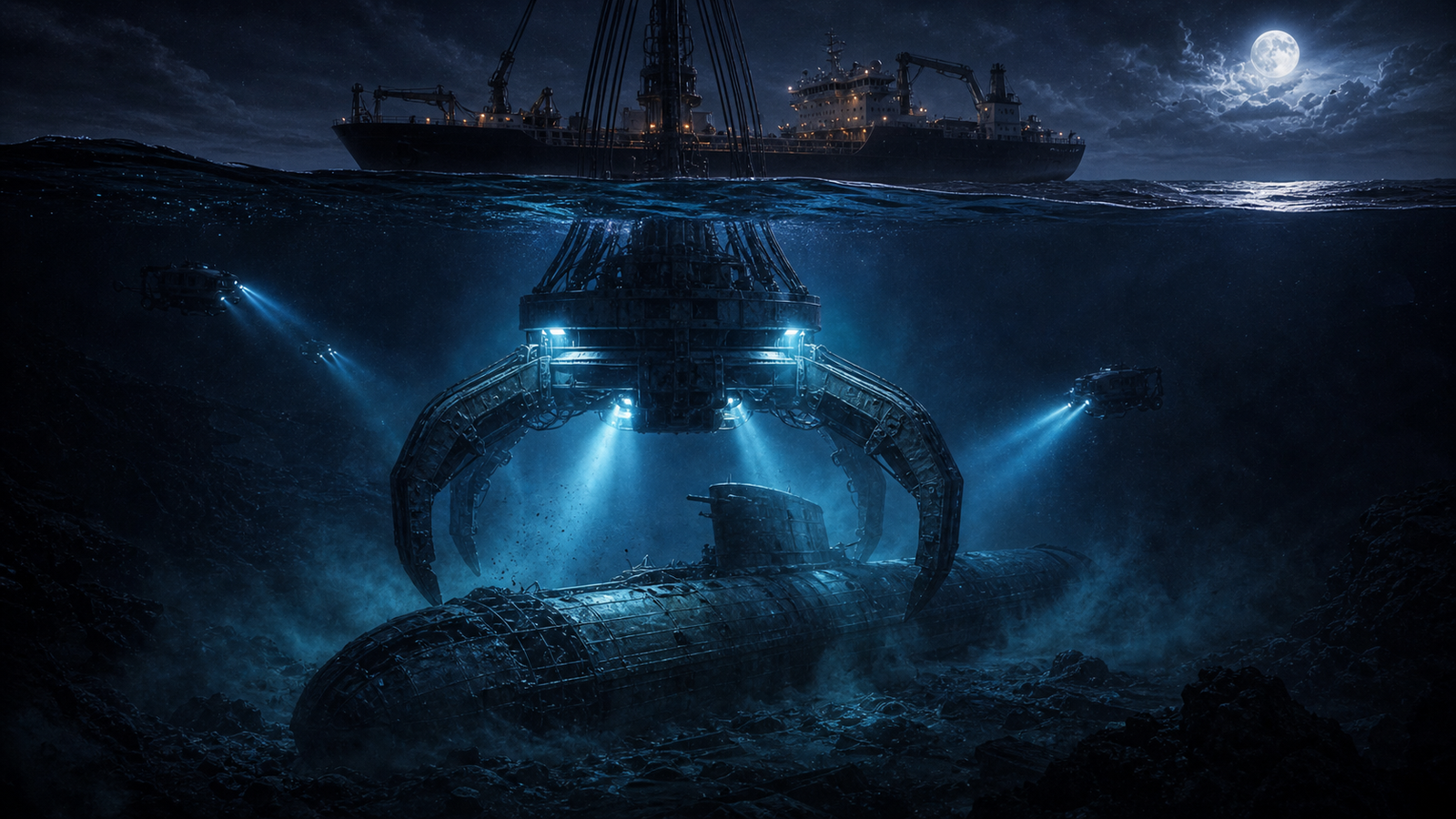
Project Azorian CIA Sunken Submarine Recovery Program
Project AZORIAN mattered because it tried to turn the ocean floor into an intelligence target.
That is the key.
What the CIA wanted was not merely a wreck. It wanted access.
It wanted:
- Soviet naval hardware,
- cryptographic material,
- missile technology,
- strategic procedures,
- and anything else still sealed inside a submarine the Soviets themselves could not recover.
In that form, Project AZORIAN became more than a salvage project.
It became one of the clearest real black programs in which covert engineering, private-sector cover, White House risk management, and deep-ocean recovery fused into one Cold War mission.
That is why it still matters.
Project AZORIAN is one of the rare black files where the target was not in the sky, on land, or in a communications network.
It was at the bottom of the Pacific.
The first thing to understand
This is not only a submarine story.
It is a covert recovery-and-secrecy architecture story.
That matters.
The submarine mattered, of course. But the operation only became historically decisive because the CIA built an entire hidden system around recovering it:
- a cover story,
- a custom ship,
- a concealed lifting mechanism,
- political approval channels,
- and a secrecy doctrine strong enough to survive years of public scrutiny.
That matters because AZORIAN was not just about what lay on the seabed. It was about how the United States decided to reach it without revealing why.
The trigger: K-129
The mission begins with the Soviet submarine K-129.
That matters.
CIA’s museum history and artifact materials say the submarine sank in 1968 to a depth of about 16,500 feet in the Pacific, and that after Soviet search efforts failed, the United States located the wreck and recognized the intelligence value that recovery might yield. [1][2][3]
That matters because the whole logic of AZORIAN depended on a rare intelligence condition: a major Soviet strategic asset had been lost somewhere the Soviets could not retrieve, but the Americans believed they might.
Why the wreck mattered so much
The submarine was valuable not as a symbol, but as a container.
That matters.
CIA’s public history says the United States recognized the immense intelligence value of recovering the submarine. [1] The mission was aimed at Soviet strategic capabilities, not at publicity.
That matters because K-129 represented the possibility of recovering:
- naval systems,
- missile technology,
- cryptologic or operational materials,
- and insights into Soviet submarine practice that might otherwise remain inaccessible.
The submarine was a sunken intelligence archive.
Why CIA led instead of the Navy
This is one of the most revealing parts of the whole file.
That matters.
CIA’s museum history says the Agency agreed to lead the recovery effort with support from the Department of Defense. [1] That is important because the mission was not treated as ordinary naval salvage.
It was intelligence recovery under covert authority.
That matters because the project needed secrecy and deniability as much as it needed engineering.
The engineering problem
AZORIAN only works historically if its engineering challenge stays visible.
That matters.
CIA’s museum history says the target was a 1,750-ton, 132-foot-long portion of the wreck lying more than three miles below the surface. [1] The Agency concluded that recovering such a mass from such depth under total secrecy was an unprecedented engineering problem.
That matters because the black-program core of AZORIAN is this: the CIA had to create a machine that could lift a submarine from abyssal depth without letting the world see what it was really doing.
The 1970 design decision
The recovery method was not obvious at first.
That matters.
CIA’s museum history states that in 1970, after careful study, CIA engineers and contractors concluded the only technically feasible method was to use a large mechanical claw attached to a heavy-duty hydraulic lift system on a specially built ship. [1]
That matters because the mission’s intelligence ambition did not become operational until the engineering became believable.
AZORIAN is one of those rare programs where the collection platform had to be invented almost from scratch.
Howard Hughes as cover
The cover story is one of the most famous parts of the operation for good reason.
That matters.
CIA’s public histories say the Agency reached out to Howard Hughes, who agreed to help provide a plausible cover story that the ship was conducting deep-ocean research and mining manganese nodules from the seabed. [1][4] The ship would be presented as a commercial deep-sea mining vessel rather than an intelligence platform.
That matters because the cover was not decoration. It was structural.
Without a believable public identity, the ship could never have sailed.
Why Hughes was the perfect front
Hughes mattered because his public image could absorb improbability.
That matters.
CIA review material explains that the Hughes empire made a useful front because it was associated with exotic, technically ambitious projects and did not have to answer to ordinary public transparency in the way a government program would. [5]
That matters because the cover story needed to sound eccentric but plausible. Howard Hughes made that possible.
The Hughes Glomar Explorer
The operation’s most famous artifact was the ship itself.
That matters.
CIA’s museum history explains that the Hughes Glomar Explorer was built over roughly four years and included:
- a derrick like an oil-drilling rig,
- pipe-handling systems,
- a huge hidden capture vehicle,
- and a central docking well known as the moon pool, large enough to conceal the recovered object inside the ship. [1]
That matters because the ship was not just transport. It was the operation.
AZORIAN’s real platform was a floating covert machine.
The moon pool and concealment
One of the cleverest features of the mission was not the claw alone, but concealment during the lift.
That matters.
CIA’s museum history says the ship’s moon pool allowed the recovered section to be brought inside the vessel, hidden from other ships, aircraft, and overhead surveillance. [1]
That matters because recovery alone was not enough. The act of recovery had to remain invisible.
That is what made the ship a black-program platform rather than merely a salvage vessel.
The capture vehicle
The claw itself became legendary.
That matters.
CIA’s artifact transcript describes the capture vehicle—nicknamed Clementine—as the mechanism that would descend to the ocean floor, grasp the submarine, and haul it upward through the lift pipe system. [3] The museum history likewise explains that the heavy-duty jaws would straddle the submarine section, grab it, and then reverse the lifting sequence section by section until it was inside the ship. [1]
That matters because the capture vehicle embodied the central gamble of the whole project: that precision salvage at abyssal depth could be made reliable enough for intelligence use.
A program in public and in secret
One reason AZORIAN remains so fascinating is that it was hidden in plain sight.
That matters.
CIA review material notes that the operation was conducted “simultaneously in secret and in the open,” with the mining cover story exposing the ship to public notice even while its true purpose remained concealed. [5]
That matters because most black programs hide by staying unseen. AZORIAN hid by staying misdescribed.
Presidential approval
The 1974 mission was not improvised in the field.
That matters.
National Security Archive publication of the declassified CIA history says that on June 7, 1974, President Nixon personally approved launching the Project AZORIAN mission, with the stipulation that recovery operations not begin until after his Moscow summit trip ended. [6] FRUS records also show mission approval and discussion at the senior policy level in late May and June 1974. [7][8]
That matters because the mission sat at the intersection of espionage and diplomacy. The White House understood the stakes.
The recovery site
The operational geography mattered too.
That matters.
CIA’s museum history places the wreck about 1,800 miles northwest of Hawaii at extreme depth. [1] National Security Archive publication of the declassified CIA history places the recovery zone about 1,560 miles northwest of Hawaii and notes the ship arrived over the site on July 4, 1974. [6]
That matters because even public sources preserve slight variation in distance phrasing. What is consistent is the operational reality: the mission unfolded in a remote Pacific zone, far from easy help and far from easy concealment if things went wrong.
July 4, 1974
The ship reached the site on Independence Day.
That matters.
CIA’s museum history says the Glomar Explorer arrived over the recovery site on 4 July 1974 and conducted salvage operations for more than two months under total secrecy. [1] CIA’s later story on the project says the ship remained under watch from nearby Soviet vessels for much of that time. [4]
That matters because the mission’s secrecy did not depend on isolation alone. It had to function while being observed by people who did not know what they were actually seeing.
Soviet surveillance
This part of the operation sharpened the danger.
That matters.
National Security Archive publication of the declassified CIA history says the recovery work was complicated by nearly 14 days of near-continuous surveillance by two Soviet naval vessels. It also records concern that Soviet helicopters might attempt to land on the ship, prompting contingency measures to block the deck and prepare for emergency destruction of sensitive material. [6]
That matters because AZORIAN was not only an engineering test. It was a counterdiscovery exercise.
The lift
Eventually the lift began.
That matters.
National Security Archive publication of the declassified CIA history says the Hughes Glomar Explorer began lifting the K-129 on August 1, 1974, and that it took eight days to winch the remains into the ship’s hold, with the sub finally secured inside on August 8. [6]
That matters because the lift was not a moment. It was an extended, high-risk sequence where every mechanical stage had to succeed under ocean motion, secrecy pressure, and strategic consequence.
The break
The most famous operational failure came during ascent.
That matters.
CIA’s public histories say that when the submarine section was roughly halfway—or in one account about a third of the way—up, it broke apart, and a large portion fell back to the ocean floor. [1][4] The crew nonetheless brought aboard the portion that remained in the capture vehicle. [1][4]
That matters because AZORIAN became one of the rare black programs where partial success still counted as an extraordinary feat.
What was recovered
This is the question everyone asks, and the public record remains incomplete.
That matters.
CIA’s museum history says the recovered section included the bodies of six Soviet submariners, who were given a formal military burial at sea. [1] The same page notes that a film of that ceremony was later presented by CIA Director Robert Gates to Russian President Boris Yeltsin in 1992. [1]
That matters because the public record confirms some recovery, but not the full intelligence yield.
Many of the most sensitive details remain redacted or uncertain.
Why the mission was still considered a coup
Even with the break, CIA still treated the operation as a landmark.
That matters.
CIA’s museum history says the Agency considered Project AZORIAN one of the greatest intelligence coups of the Cold War and an engineering marvel that advanced deep-ocean mining and heavy-lift technology. [1] CIA’s 2025 collection summary similarly calls it one of the most complex technical missions of the Cold War. [9]
That matters because success in black programs is not always binary. AZORIAN did not recover everything, but it recovered enough to secure its place in intelligence history.
The “Jennifer” confusion
This is one point where precision matters a lot.
That matters.
Later popular retellings often called the mission Project Jennifer. But CIA review material says that Jennifer was the name for the security system or compartment, not the overall project name, which was AZORIAN. [5]
That matters because the naming confusion has been repeated for decades. A good history file should separate the project name from the compartment label.
Why the distinction matters
It is not just trivia.
That matters.
Compartmented black programs often leave behind distorted names because outsiders encounter security labels, cover terms, and codewords out of context. AZORIAN is a classic case.
That matters because the public memory of a covert program is often shaped by the leaks rather than by the actual internal structure.
The burglary and exposure
One of the strangest turns in the entire story came before the mission had even fully settled into secrecy.
That matters.
CIA’s museum history says that in June 1974, thieves broke into one of the Hughes-associated offices in Los Angeles and stole secret documents, including one that tied Howard Hughes to CIA and the Glomar Explorer. [1] CIA’s 2020 story says the Agency called in the FBI, which in turn involved the Los Angeles Police Department, helping generate the attention that later fed the press story. [4]
That matters because AZORIAN was not destroyed by Soviet discovery during the lift. It was fatally weakened by a burglary on land.
The 1975 leaks
The public collapse came soon after.
That matters.
CIA’s museum history says the Los Angeles Times published a revealing account on February 7, 1975, after which Jack Anderson carried the story to a national audience. [1] CIA’s 2020 retelling describes the 1975 reporting as the point at which one of CIA’s greatest intelligence coups was fully exposed. [4]
That matters because the secrecy shell finally broke in public. And once it broke, the second mission became politically untenable.
MATADOR
A second attempt was planned.
That matters.
CIA review material says the proposed follow-on mission to recover the lost section was code-named MATADOR. [5] The same review notes that the White House ultimately killed Colby’s proposal for that second Glomar mission after the leaks and political pressure surrounding the first operation. [5]
That matters because AZORIAN’s story does not end with the 1974 lift. It ends with the loss of the chance to finish the job.
The White House cancellation
CIA’s public history says that once the press exposure blew the cover, the White House canceled further recovery operations. [1]
That matters because this is where black-program reality asserts itself: technical success can be real, but political survival is a separate requirement.
AZORIAN had the first. It lost the second.
The birth of the Glomar response
Project AZORIAN also left behind one of the most famous phrases in secrecy law and public-records practice.
That matters.
CIA artifact material says the phrase “We can neither confirm nor deny” originated in the Agency’s handling of inquiries after the Glomar mission. [3] NARA’s FOIA Ombuds page likewise explains that the term “Glomar” in FOIA practice comes directly from the effort to avoid confirming or denying records related to the Hughes Glomar Explorer operation. [10]
That matters because AZORIAN changed not only intelligence history, but also the language of secrecy itself.
Why AZORIAN matters beyond espionage
The operation also matters as a measure of what covert engineering can become when intelligence demand is extreme enough.
That matters.
The CIA did not simply charter a ship. It created:
- an entire cover industry,
- a custom vessel,
- a hidden capture system,
- and a months-long maritime choreography designed to make one impossible recovery attempt appear mundane.
That matters because many black programs hide their purpose. AZORIAN had to manufacture a whole false purpose.
What the strongest public-facing record actually shows
The strongest public-facing record shows something very specific.
It shows that Project AZORIAN was the CIA-led covert effort to recover at least part of the sunken Soviet submarine K-129 from the Pacific Ocean floor; that the operation relied on the specially built Hughes Glomar Explorer under a Howard Hughes deep-sea-mining cover story; that higher authority approved the 1974 mission before the ship arrived over the site on July 4, 1974; that the submarine section broke apart during the lift and only part was successfully brought aboard; that the project name was AZORIAN rather than Jennifer, which referred instead to a security compartment; and that leaks in 1975 destroyed the cover, killed plans for a second mission, and helped create the enduring “Glomar response” phrase.
That matters because it gives Project AZORIAN its exact place in history.
It was not only:
- a salvage story,
- a Cold War curiosity,
- or the origin of a legal phrase.
It was a real intelligence recovery operation that tried to steal Soviet secrets from the bottom of the sea.
Why it matters in this encyclopedia
This entry matters because Project Azorian CIA Sunken Submarine Recovery Program explains how far the Cold War was willing to go to recover information that could not be photographed, intercepted, or recruited out of a human source.
Instead of merely observing the target, the CIA tried to raise it.
Instead of hiding the operation behind silence, the Agency hid it behind industry.
Instead of admitting the mission after exposure, the state created a doctrine of refusal that still shapes records practice.
That matters.
Project AZORIAN is not only:
- a K-129 page,
- a Hughes Glomar Explorer page,
- or a Howard Hughes page.
It is also:
- a CIA engineering page,
- a deep-ocean recovery page,
- a secrecy-law page,
- a compartmentation page,
- and a black-program exposure page.
That makes it one of the strongest foundation entries in the archive.
Frequently asked questions
What was Project AZORIAN?
Project AZORIAN was the CIA’s covert effort to recover at least part of the sunken Soviet ballistic-missile submarine K-129 from the Pacific Ocean floor using the specially built Hughes Glomar Explorer.
Was Project AZORIAN a real CIA program?
Yes. CIA historical pages, National Security Archive releases, and FRUS documents all firmly establish AZORIAN as a real Cold War recovery operation.
Was the project really called Jennifer?
No, not exactly. Later CIA review material says Jennifer referred to the security compartment, not the overall project name, which was AZORIAN.
Did the Hughes Glomar Explorer recover the whole submarine?
No. CIA’s public history says the recovered section broke partway through the lift and a portion fell back to the ocean floor, leaving only part successfully brought aboard.
Why is the Glomar response connected to AZORIAN?
Because the government’s effort to protect records and details about the mission produced the famous formulation that it could neither confirm nor deny the existence of the responsive records.
Related pages
- Black Projects
- Project Aquatone U-2 Spy Plane Black Program
- Project Aquacade Signals Intelligence Satellite Program
- Project Argon Mapping Spy Satellite Program
- Project Acoustic Kitty CIA Animal Spy Program
Suggested internal linking anchors
- Project Azorian CIA sunken submarine recovery program
- Project AZORIAN
- CIA Glomar Explorer history
- Project Azorian K-129 recovery
- Project Azorian Jennifer confusion
- Glomar response origin
- Project AZORIAN MATADOR
- declassified Project AZORIAN history
References
- https://www.cia.gov/legacy/museum/exhibit/project-azorian/
- https://www.cia.gov/legacy/museum/artifact/flag-that-flew-above-the-glomar-explorer/
- https://www.cia.gov/legacy/museum/artifact/flag-that-flew-above-the-glomar-explorer/
- https://www.cia.gov/stories/story/the-exposing-of-project-azorian/
- https://www.cia.gov/resources/csi/static/The-Glomar-Explorer.pdf
- https://nsarchive2.gwu.edu/nukevault/ebb305/index.htm
- https://history.state.gov/historicaldocuments/frus1969-76v35/ch4
- https://history.state.gov/historicaldocuments/frus1969-76v35/d186
- https://www.cia.gov/static/cdfb671704c790a62fbbb6f0f9335042/InsideTheCollection_Digital_Mar2025.pdf
- https://foia.blogs.archives.gov/2024/01/25/what-the-foia-is-glomar/
- https://www.cia.gov/resources/csi/static/The-Glomar-Explorer.pdf
- https://www.cia.gov/readingroom/document/0005301269
- https://www.cia.gov/spy-kids/games/images/Azorian-Worksheets-13-and-Up-AnswerKey.pdf
- https://www.cia.gov/legacy/museum/artifact/manganese-nodule-encased-in-lucite/
- https://www.cia.gov/resources/csi/static/Intel-Officers-Bookshelf-56.4.pdf
Editorial note
This entry treats Project AZORIAN as one of the most important covert-recovery files in the entire black-projects archive.
That is the right way to read it.
AZORIAN matters because it proves intelligence collection is not always about seeing or listening. Sometimes it is about building a way to take the target physically out of the environment that hides it. That is the deeper significance of the project. The CIA did not simply locate K-129 and accept the knowledge. It decided to build an entire floating industrial fiction around the possibility of stealing the wreck from the ocean floor. That meant not just a cover story, but a ship, a moon pool, a capture vehicle, a recovery doctrine, and political discipline strong enough to hold the lie together while Soviet ships looked on. The operation only partially succeeded, and the public record still does not disclose every intelligence yield. But that does not diminish its significance. In some ways it heightens it. Project AZORIAN remains one of the best examples of a black program whose ambition was larger than its final haul and whose exposure changed the public language of secrecy forever.