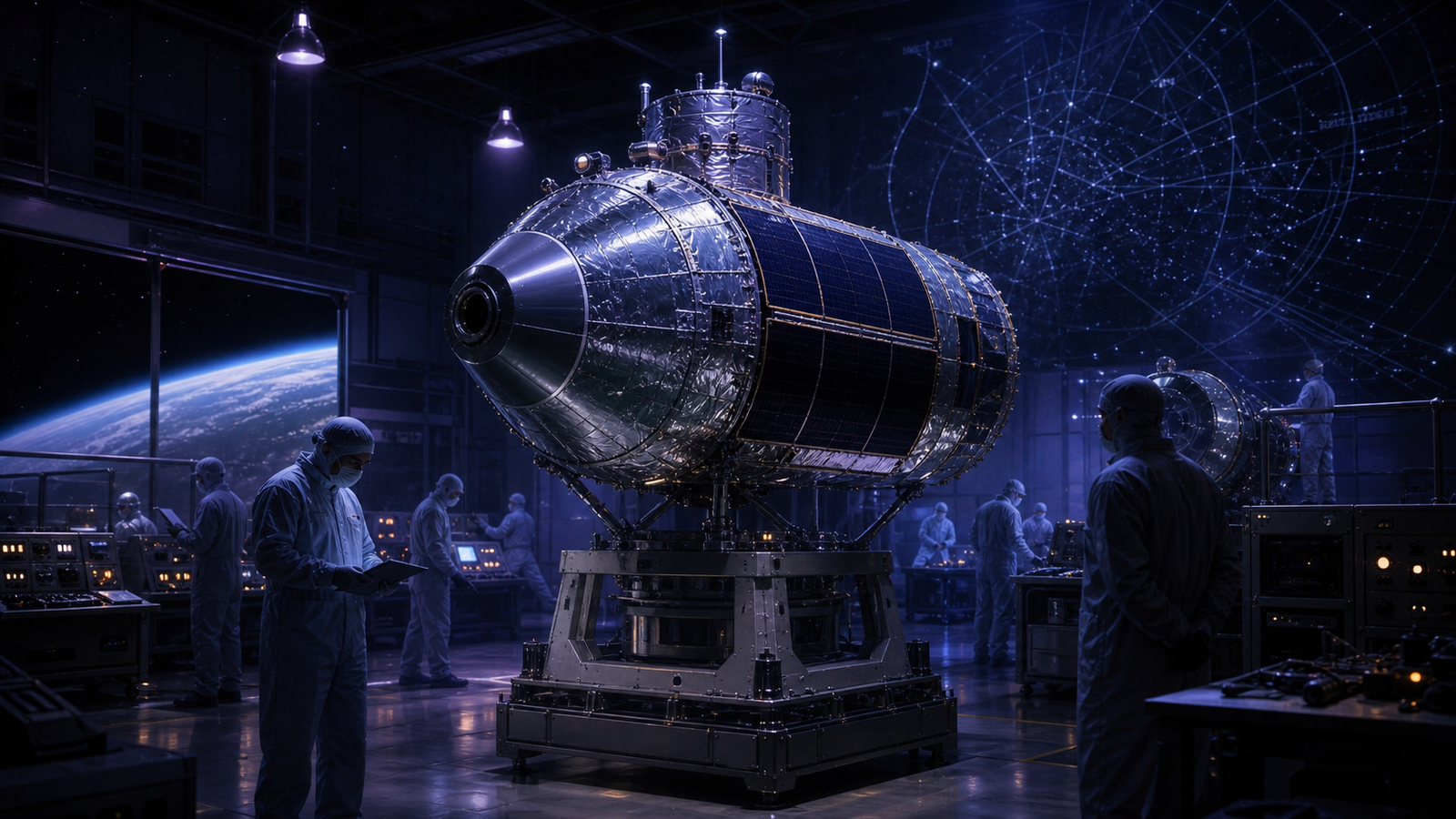
Project CORONA First American Spy Satellite Program
Project CORONA was one of the most important real black programs in American intelligence history.
Not rumored. Not merely alleged. Not a thin conspiracy file.
It was a verified, declassified, Cold War photo-reconnaissance satellite program.
Its job was simple to describe and extremely difficult to execute:
- put a camera in orbit,
- photograph denied territory,
- expose physical film in space,
- seal that film inside a reentry capsule,
- drop the capsule back through the atmosphere,
- and recover it before the ocean destroyed it.
That was CORONA.
It was America's first successful spy-satellite system.
The public knew it as Discoverer. The black world knew it as CORONA.
That difference matters.
Discoverer sounded like science, engineering, and space-age experimentation. CORONA was reconnaissance.
The program existed because the United States needed a way to see inside the Soviet Union and other denied regions without sending pilots into airspace where they could be shot down, captured, or used as proof of espionage.
The solution was not digital. It was not real-time video. It was not the sleek satellite imagery people imagine today.
It was a film camera in orbit and a falling bucket of negatives.
That is what makes CORONA so powerful as a black-project entry.
It is both primitive and futuristic at once.
The first thing to understand
CORONA was not built in a normal technology-development environment.
It was built under strategic pressure.
In the 1950s, U.S. leaders feared Soviet missile and bomber strength but had limited reliable ways to measure it. High-altitude reconnaissance aircraft, especially the U-2, could collect critical imagery, but aircraft overflights were politically explosive and increasingly dangerous.
The National Reconnaissance Office's public history says President Eisenhower approved CORONA on 7 February 1958 after a film-return approach was separated from the broader Air Force WS-117L satellite reconnaissance effort and treated as a crash program. [1]
That origin explains the whole program.
CORONA was not created because satellites were glamorous. It was created because existing methods were too risky, too limited, and too slow.
Why the Discoverer cover story mattered
The program had to hide in plain sight.
That matters.
The CIA says CORONA was publicly known as the U.S. Air Force's Discoverer program while the classified project collected imagery over denied areas of eastern Europe and Asia. [2]
That cover was not just cosmetic.
It allowed launches, test failures, capsules, biological experiments, and satellite hardware to be discussed publicly without admitting that the United States was building an orbital espionage system.
In Black Echo terms, Discoverer is the surface layer. CORONA is the buried layer.
The public name says:
- space science,
- technology testing,
- recovery experiments,
- peaceful exploration.
The classified mission says:
- Soviet missile fields,
- bomber bases,
- Chinese targets,
- denied-area photography,
- strategic intelligence.
That is the architecture of a real black program.
Why CORONA became urgent after the U-2 crisis
The downing of Francis Gary Powers' U-2 in May 1960 changed the political atmosphere around overhead reconnaissance.
The NRO history notes that the Powers shootdown gave CORONA another push for urgency. [1]
That matters because CORONA was not just a technical experiment after that point. It became a solution to a diplomatic and strategic problem.
Aircraft could be denied. Aircraft could be shot down. Pilots could be captured.
A satellite was different.
It crossed borders from orbit. It did not need a pilot. It could collect over enormous areas. It could do what aircraft could do only at extreme risk.
CORONA did not end reconnaissance danger. But it changed the battlefield.
It moved the eye from airspace to space.
The black engineering problem
CORONA's central problem was brutal.
How do you take high-quality photographs in space before digital imagery transmission is mature enough to solve the problem?
The answer was analog.
Use film.
That created a second problem.
How do you get the film back?
The answer was a reentry capsule.
That created a third problem.
How do you recover a small capsule falling from orbit before it is lost?
The answer was aerial recovery.
The Smithsonian's National Air and Space Museum describes CORONA capsules separating from the satellite, reentering the atmosphere, jettisoning the heat shield, deploying a parachute, and then being gathered by an Air Force plane. [3]
That is the unforgettable image of CORONA:
a spy satellite taking photographs over the Soviet Union, then dropping a metal capsule through the sky so a military aircraft can hook it before it disappears into the ocean.
It sounds like fiction. It was real.
Failure before breakthrough
CORONA did not work cleanly at first.
That matters.
The NRO history says the program suffered twelve failed missions because of launch vehicle, satellite, or recovery system problems, and that a thirteenth spacecraft succeeded only as a test vehicle with no film. [1]
That is important for the way this entry should be read.
Real black projects do not always look like omnipotent secret machines.
They fail. They explode. They lose capsules. They break film. They miss recovery zones. They produce blur, blank frames, and wreckage.
CORONA became legendary not because it was perfect from day one, but because the system survived enough failure to eventually work.
Discoverer 14 and the first real success
The breakthrough came in August 1960.
The NRO states that the first fully successful CORONA mission launched on 18 August 1960 and was recovered the next day. That mission returned 3,000 feet of film and imaged 1.65 million square miles of Soviet territory. [1]
That single mission mattered enormously.
The first real CORONA success gave U.S. analysts more photographic coverage than all previous U-2 missions combined, according to the NRO's historical summary. [1]
That is the strategic pivot.
Before CORONA, the United States had fragments. After CORONA, it had broad-area coverage from orbit.
The camera had escaped the aircraft.
The first spy photos from space
The Discoverer 14 recovery was not just a program milestone.
It was a world-historical intelligence event.
The Smithsonian describes the August 19, 1960 recovery as the first midair recovery of a capsule returning from orbit and says the capsule contained the first spy photos taken from space of the Soviet Union. [4]
That is why CORONA belongs at the center of the Black Echo black-project archive.
It is one of the cleanest examples of a secret program that genuinely changed history.
Not by creating a strange weapon. Not by staging a fake event. Not by hiding alien wreckage.
By making strategic uncertainty visible.
The Keyhole camera lineage
CORONA was not one satellite.
It was a family of systems.
The USGS notes that the intelligence community used Keyhole designators and that CORONA systems were designated KH-1, KH-2, KH-3, KH-4, KH-4A, and KH-4B. [5]
That matters because CORONA evolved.
The early systems were crude compared with later satellites. The later systems delivered better resolution, more film capacity, and stereo imagery.
The NRO states that early CORONA missions produced about 40-foot ground resolution, while later KH-2 and KH-3 systems improved to about 10 feet, and the final KH-4 system ultimately produced about 5-to-7-foot resolution. [1]
Those numbers are not just technical trivia.
They show the program turning from emergency experiment into operational intelligence architecture.
The film-return capsule as black-project icon
The film-return capsule is the symbolic heart of CORONA.
It carried the evidence.
It held the negatives that would become estimates, maps, briefings, target folders, and strategic decisions.
The Smithsonian record for a CORONA film return capsule says the satellite's film was reeled onto spools inside the capsule, separated from the satellite, and brought back through the atmosphere for aircraft recovery. [3]
That capsule is the perfect black-project object.
It is small enough to sit in a museum. But it once carried the strategic picture of the planet.
It is not a weapon. It is not a spacecraft in the cinematic sense.
It is a container for seeing.
Why the missile gap matters
CORONA changed the intelligence argument around Soviet strategic power.
That matters.
The NRO says CORONA imagery showed the Soviets had far fewer strategic missiles than had been thought and helped dispel the early-1960s idea of a missile gap. [1]
That line is one of the most important historical claims around the program.
CORONA did not merely take photographs. It changed estimates.
It helped answer questions like:
- How many missile sites exist?
- Where are the bomber bases?
- How fast is the Soviet strategic force growing?
- Are worst-case assumptions justified?
- Is the United States blind inside denied territory?
Before CORONA, a great deal depended on inference. After CORONA, analysts had imagery.
Not perfect truth. But better evidence.
Why CORONA belongs beside the U-2
CORONA and the U-2 should be read together.
The U-2 represents the last great age of risky manned overflight. CORONA represents the beginning of operational space reconnaissance.
They are not enemies in the historical record. They are connected phases.
The U-2 proved the intelligence value of high-altitude imagery. The U-2 crisis proved the political danger of that method. CORONA carried the imaging mission into orbit.
That is why this file should link internally to any Project AQUATONE / U-2 entry.
AQUATONE is the aircraft eye. CORONA is the orbital eye.
Together they show how the intelligence state moved upward.
CORONA as the foundation of the NRO era
The National Reconnaissance Office was formally created after CORONA began, but CORONA belongs to the origin story of U.S. national reconnaissance.
That matters.
The NRO's public mission today is designing, building, launching, and operating U.S. intelligence satellites. [6]
CORONA was one of the foundational proof points for that world.
It proved that national decision-makers would rely on satellites for intelligence collection. It proved that industry, CIA, Air Force, and classified management structures could build systems beyond public view. It proved that orbital collection could reshape strategic analysis.
The modern black satellite ecosystem begins here.
What the public saw
The public saw Discoverer launches.
They saw space technology. They saw capsule recovery tests. They saw the United States competing in the space age. They did not see the full reconnaissance mission.
That matters because CORONA was not hidden by making it invisible.
It was hidden by giving visible events a different explanation.
That is often more effective.
The launch can be public. The payload story can be false. The recovery can be explained. The target list can remain classified.
CORONA is a case study in managed visibility.
What the classified system actually did
The core system was simple in outline:
- launch a satellite from Vandenberg,
- place it into an orbit useful for target coverage,
- expose film through a panoramic camera system,
- wind the film into a recovery vehicle,
- eject the capsule,
- de-orbit it,
- deploy a parachute,
- recover it by aircraft or from the water,
- process the film,
- interpret the imagery.
The USGS describes the successful CORONA mission structure in exactly this broad pattern: telescopic cameras acquired photographs, exposed film was loaded into recovery capsules, capsules were de-orbited and retrieved by aircraft, and the film was developed for military analysis. [5]
That makes CORONA one of the great analog intelligence systems.
It is not modern cloud imagery. It is not a real-time dashboard.
It is orbital film logistics.
The improvement curve
CORONA's improvement curve is what made it operationally valuable.
The early KH-1 system was limited. Later systems improved camera quality and mission design. The KH-4 and later variants used dual panoramic cameras for stereo coverage. The USGS notes that later CORONA systems, including KH-4, KH-4A, and KH-4B, carried two panoramic cameras with a 30-degree separation angle, one looking forward and one aft. [5]
That stereo capability mattered because imagery was not just for seeing flat shapes.
It could help estimate:
- height,
- layout,
- facility construction,
- airfield characteristics,
- missile deployment patterns,
- and terrain relationships.
CORONA did not simply make photographs. It made intelligence geometry.
What CORONA was not
This distinction matters.
CORONA was not a secret alien-monitoring satellite. It was not a space weapon. It was not a public weather satellite hiding a cosmic agenda. It was not primarily a UFO system.
It was a strategic photo-reconnaissance program.
That is already extraordinary enough.
In conspiracy culture, real black programs are often inflated until their actual significance is lost.
CORONA does not need inflation.
Its documented history is already larger than most legends.
It secretly photographed denied territory from space, corrected national intelligence estimates, and helped create the satellite reconnaissance era.
That is the point.
The relationship to ARGON and LANYARD
CORONA was later declassified with two sister systems: ARGON and LANYARD.
CIA's CORONA declassification page identifies ARGON as a mapping-imagery sister program and LANYARD as a short-lived higher-quality imagery effort. [2]
The USGS also groups CORONA, ARGON, and LANYARD together as first-generation U.S. photo-intelligence satellite systems whose images were later declassified. [5]
That matters for internal linking.
CORONA is the broad first spy-satellite foundation. ARGON is the mapping companion. LANYARD is the experimental short-lived cousin.
Together they form a first-generation film-return archive.
Why the archive matters now
CORONA did not end in 1972 in a cultural sense.
It had a second life after declassification.
The CIA says that during its operational life CORONA collected more than 800,000 images, and that Executive Order 12951 released CORONA, ARGON, and LANYARD imagery to the public in 1995. [2]
USGS describes the declassified collection as more than 860,000 images from CORONA, ARGON, and LANYARD, collected between 1960 and 1972. [5]
That difference in number is not a contradiction worth overreading.
Different agencies are describing closely related release sets and archive products. The important point is the scale.
Hundreds of thousands of images moved from the black world into public research.
Executive Order 12951
The official declassification trail is clear.
The Federal Register lists Executive Order 12951, signed by President William J. Clinton on 22 February 1995, concerning the release of imagery acquired by space-based national intelligence reconnaissance systems. [7]
The order directed the release of imagery from the CORONA, ARGON, and LANYARD missions.
This is what makes CORONA such a strong entry.
The program has:
- official history,
- technical artifacts,
- imagery archives,
- executive declassification records,
- museum holdings,
- and public research use.
It is not a rumor preserved only in retellings. It is a black program with a paper trail, hardware trail, and image trail.
The environmental and archaeological afterlife
One of the strangest things about CORONA is what happened after secrecy.
Images made for Cold War reconnaissance became historical Earth data.
USGS explains that CORONA, ARGON, and LANYARD imagery was originally used for reconnaissance and mapping, but was later considered valuable for global change research and declassified because the data was no longer critical to national security. [5]
That means CORONA now helps researchers study landscapes as they looked decades ago.
What began as a machine for watching adversaries became a time capsule of the Earth.
That is a very Black Echo transformation.
The secret eye becomes an archive.
Why CORONA feels mythic even when documented
CORONA has all the ingredients of a myth:
- a hidden name,
- a public cover story,
- orbital cameras,
- falling capsules,
- aircraft catching parachutes,
- Soviet targets,
- failed missions,
- a final breakthrough,
- a massive secret archive,
- and declassification decades later.
But it is not myth in the weak sense.
It is mythic because it is real.
That is why this entry should be written differently from a thin theory dossier.
The tone should still be atmospheric. But the evidence boundary is strong.
CORONA is not presented as "possibly real."
It is real.
The mystery is not whether it existed. The mystery is how a system this ambitious worked at all.
The black-project lesson
CORONA teaches a major lesson about black programs.
The most important secret projects are not always the ones with the strangest claims.
Sometimes they are the ones that quietly change what governments can know.
CORONA changed the intelligence state because it changed the scale of seeing.
Before CORONA, denied territory was hidden behind borders, air defenses, and uncertainty. After CORONA, the United States could repeatedly image broad areas from orbit.
That did not make intelligence perfect. But it changed the baseline.
Strategic analysis could now start with photographs.
What the strongest public record supports
The strongest public record supports a very clear conclusion.
It supports that CORONA was a real CIA and U.S. Air Force photo-reconnaissance satellite program approved by Eisenhower in 1958; publicly hidden behind the Discoverer program; built around film-return satellites and aerial capsule recovery; first fully successful with the August 1960 Discoverer 14 mission; operated through multiple Keyhole generations until 1972; helped dispel exaggerated missile-gap fears by showing that Soviet strategic forces were smaller than some estimates had suggested; and was largely declassified in 1995 under Executive Order 12951, after which CORONA imagery became a public archive held through NARA and USGS. [1][2][3][5][7]
That is enough.
No extra legend is required.
Why it matters in this encyclopedia
This entry matters because Project CORONA First American Spy Satellite Program is one of the anchor cases for the entire declassified black-project archive.
It proves that:
- real black programs exist,
- public cover stories can hide classified missions,
- satellite intelligence reshaped the Cold War,
- declassification can expose enormous hidden systems decades later,
- and not every powerful secret has to be supernatural or extraterrestrial.
CORONA is a bridge entry.
It connects:
- U-2 overflights,
- the missile gap,
- CIA technical collection,
- Air Force space operations,
- NRO origin history,
- Keyhole imagery systems,
- ARGON and LANYARD,
- GAMBIT and HEXAGON,
- public declassified imagery,
- and the modern satellite surveillance world.
It is one of the best examples of a black project becoming a public historical object without losing its aura.
The film capsule is in the museum. The imagery is in the archive. The cover story is documented. The mission is no longer speculative.
But the atmosphere remains.
A secret camera looked down from orbit. A metal capsule fell through the sky. An aircraft hooked the parachute. And inside the bucket was the Cold War, waiting to be developed.
Frequently asked questions
Was Project CORONA a real black program?
Yes. CORONA was a real, highly classified CIA and Air Force photo-reconnaissance satellite program later declassified through official records, museum artifacts, and public imagery archives.
Why was CORONA publicly called Discoverer?
Discoverer functioned as the public cover story. It presented launches as scientific or technological satellite missions while the classified CORONA payload gathered reconnaissance imagery.
What was the first successful CORONA mission?
Discoverer 14, launched on 18 August 1960, was the first fully successful CORONA mission. Its film capsule was recovered the next day, returning usable photographic intelligence from orbit.
How did CORONA get photographs back to Earth?
CORONA exposed film in orbit, wound the film into a recovery capsule, de-orbited the capsule, deployed a parachute after reentry, and relied on specially equipped Air Force aircraft to recover the capsule, often in midair.
Why did CORONA matter to the missile gap?
CORONA imagery showed that Soviet missile and bomber deployments were smaller than some worst-case estimates suggested. It gave U.S. leaders photographic evidence instead of relying only on inference, reports, or risky aircraft overflights.
When was CORONA declassified?
Most CORONA, ARGON, and LANYARD imagery was declassified in 1995 under Executive Order 12951, signed by President Bill Clinton.
Is CORONA connected to later spy satellite programs?
Yes. CORONA was part of the first generation of U.S. reconnaissance satellites and sits in the lineage that leads toward later systems such as GAMBIT, HEXAGON, and broader NRO space-based intelligence collection.
Related pages
- Black Projects
- Project ARGON Mapping Spy Satellite Program
- Project CANYON SIGINT Satellite Black Program
- Project CHALET SIGINT Satellite Black Program
- Project GAMBIT High Resolution Spy Satellite Program
- Project HEXAGON Big Bird Reconnaissance Satellite Program
- Project AQUATONE U-2 Spy Plane Black Program
Suggested internal linking anchors
- Project CORONA first American spy satellite program
- CORONA spy satellite program
- Discoverer cover story
- Discoverer 14 first spy photos from space
- CORONA film return capsule
- CORONA missile gap intelligence
- CORONA KH-1 KH-4 satellite history
- CORONA declassified black program
- CIA Air Force satellite reconnaissance
- NRO CORONA history
References
- https://www.nro.gov/About-NRO/history/history-corona/
- https://www.cia.gov/stories/story/corona-declassified/
- https://airandspace.si.edu/collection-objects/reentry-capsule-film-return-corona/nasm_A19950118000
- https://airandspace.si.edu/multimedia-gallery/image/4281hjpg
- https://www.usgs.gov/centers/eros/science/usgs-eros-archive-declassified-data-declassified-satellite-imagery-1
- https://www.intelligence.gov/how-the-ic-works/our-organizations/nro
- https://www.federalregister.gov/documents/1995/02/28/95-5050/release-of-imagery-acquired-by-space-based-national-intelligence-reconnaissance-systems
- https://www.presidency.ucsb.edu/documents/executive-order-12951-release-imagery-acquired-space-based-national-intelligence
- https://www.cia.gov/readingroom/document/cia-rdp76b00734r000100140006-0
- https://www.cia.gov/readingroom/docs/CIA-RDP89B00980R000500070001-2.pdf
- https://www.nro.gov/Portals/65/documents/history/csnr/corona/The%20CORONA%20Story.pdf
- https://www.nro.gov/Portals/135/documents/history/csnr/corona/Intel_Revolution_Web.pdf
- https://www.cia.gov/resources/csi/static/3d24f7019bf7e718fd1d2a5c57e6a646/corona.pdf
- https://www.cia.gov/static/Corona-Between-the-Sun-and-the-Earth.pdf
- https://www.nro.gov/Portals/65/documents/news/press/1995/1995-01.pdf
Editorial note
This entry treats Project CORONA as a verified declassified black program.
That is the correct reading.
CORONA does not need to be exaggerated into something else to matter. Its confirmed history is already extraordinary: a covert satellite system approved by Eisenhower, hidden behind the Discoverer cover story, operated by the CIA and Air Force, built around analog film-return technology, repeatedly failed before succeeding, and ultimately responsible for some of the first decisive spy photographs taken from orbit. Its imagery helped reshape U.S. estimates of Soviet strategic power and became a central part of the transition from dangerous aircraft overflights to routine space-based reconnaissance. Decades later, the same imagery moved into public archives and became useful for history, environmental research, mapping, and archaeology. That full arc—from black program to museum object to public Earth archive—is exactly why CORONA belongs in the declassified section. It is not just a spy-satellite story. It is a story about how secrecy becomes infrastructure, how infrastructure becomes intelligence, and how intelligence eventually becomes history.