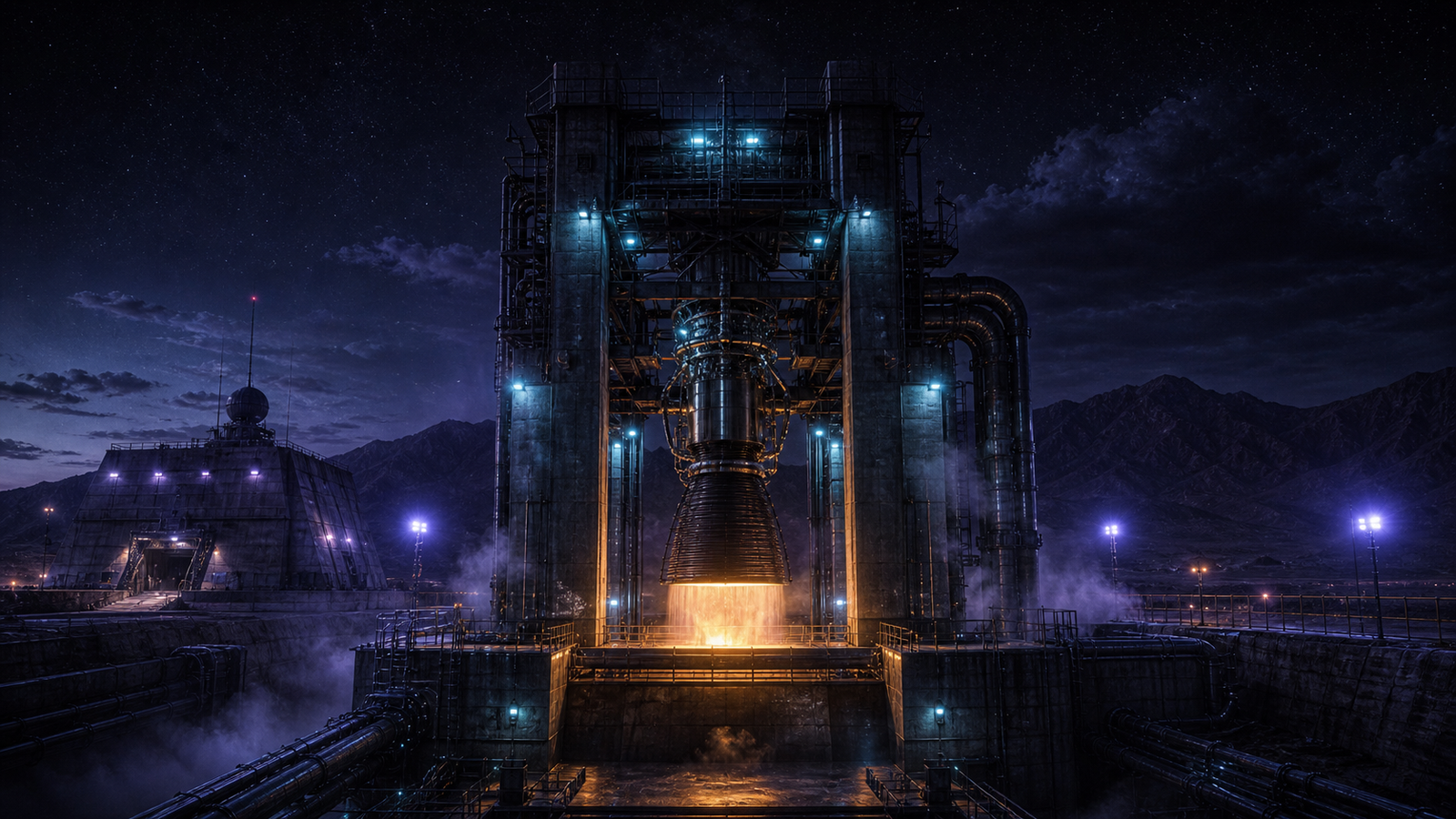
Project ROVER Nuclear Rocket Black Program
Project ROVER was the atomic engine room of the post-Apollo future that never arrived.
It was real.
It was not a rumor invented by secret-space forums. It was not an alien propulsion program. It was not a confirmed hidden Mars fleet.
It was something more grounded and, in some ways, more impressive:
a U.S. nuclear thermal rocket development program that tried to make a reactor behave like a rocket engine.
The concept was direct and terrifyingly elegant.
Pump liquid hydrogen through an intensely hot nuclear reactor. Let the reactor heat the hydrogen. Expel that hydrogen through a nozzle. Use the exhaust as thrust.
No chemical combustion chamber. No ordinary rocket flame. No oxidizer in the engine cycle.
Just reactor heat turned into space propulsion.
That was Project ROVER's core dream.
The first thing to understand
Project ROVER was the umbrella.
That matters.
Many people encounter the story through NERVA, the Nuclear Engine for Rocket Vehicle Application. NERVA was the more flight-oriented engine program. But ROVER was the deeper reactor-development foundation beneath it.
ROVER is the archive where the branch names gather:
- Kiwi,
- Phoebus,
- Pewee,
- Nuclear Furnace,
- RIFT,
- and NERVA.
Each name is a doorway into the same nuclear rocket corridor.
Kiwi proved early ideas. Phoebus pushed toward enormous power. Pewee explored compact, high-performance reactor design. Nuclear Furnace tested fuel and reactor behavior. RIFT was the flight-test bridge that never launched. NERVA was the engine application that almost carried the program into operational spaceflight.
ROVER was the hidden spine.
Why nuclear thermal rockets mattered
Chemical rockets are powerful, but they pay a performance tax.
That matters.
A chemical rocket must carry fuel and oxidizer. A nuclear thermal rocket does not burn propellant in the same way. It uses a reactor as the heat source and a light propellant, usually hydrogen, as the working fluid.
In mission-planning terms, this promised a major advantage.
A nuclear thermal rocket could, in principle, deliver higher efficiency than chemical propulsion while still producing much more thrust than low-thrust electric propulsion.
That made it attractive for missions beyond low Earth orbit:
- large lunar logistics,
- crewed Mars missions,
- heavy deep-space payloads,
- high-energy upper stages,
- reusable nuclear shuttles,
- and post-Apollo architectures that needed more than Saturn-era chemical propulsion could comfortably provide.
The program's mythology grew because its logic was so powerful.
If America had gone directly from Apollo to Mars, ROVER and NERVA might have been the engine room.
The Los Alamos core
ROVER belonged to the world of Los Alamos.
That matters.
The same national laboratory culture that had shaped nuclear weapons physics became part of the effort to redirect nuclear energy toward propulsion.
This was not an ordinary aerospace program. It was not just a NASA contractor exercise. It sat at the intersection of:
- reactor physics,
- high-temperature materials,
- hydrogen flow,
- nuclear safety,
- launch vehicle planning,
- national prestige,
- and Cold War military logic.
Los Alamos brought the reactor expertise. The Atomic Energy Commission brought nuclear authority. NASA brought the spaceflight mission need. The Nevada Test Site brought the desert infrastructure where the engines could be run without pretending they were clean machines.
That combination gives ROVER its black-project aura.
Not because it was imaginary. Because it was too real to fit into ordinary spaceflight nostalgia.
The Nevada desert as launchpad substitute
ROVER did not reach orbit.
But it did become physical.
The physical heart of the program was the nuclear rocket test infrastructure in Nevada: the Nuclear Rocket Development Station, near the Nevada Test Site's wider atomic landscape.
This was where the future was rehearsed on Earth.
A nuclear rocket engine could not simply be tested like a normal laboratory device. It involved reactor startup, cryogenic propellant, radioactive exhaust concerns, shielding, remote handling, contaminated hardware, and test stands built for machines that were both engines and reactors.
That is one reason the program feels like a black-project archive even when the official record is public.
Its test environment belonged to the same desert geography as nuclear weapons testing, secret aircraft mythology, and Cold War atomic infrastructure.
The Mars engine was born in a place already coded as forbidden.
Kiwi: the first proving bird
The early ROVER reactor family was Kiwi.
That matters.
The name was symbolic. A kiwi is a flightless bird. The early nuclear rocket reactors were not intended to fly either. They were test systems designed to prove whether the basic reactor-heated-hydrogen concept could work.
Kiwi established the early technical path.
Could a reactor core survive the thermal stresses? Could hydrogen be heated fast enough? Could reactor power be controlled under rocket-like flow conditions? Could materials survive hot hydrogen without breaking down? Could an engine be shut down, restarted, and treated as more than a one-time nuclear fire?
The answers were not easy.
ROVER was not just a matter of putting a reactor behind a nozzle. The reactor had to become a rocket component: compact, high power, high temperature, responsive, stable, and survivable.
Kiwi was where that translation began.
Phoebus: power as ambition
If Kiwi was proof, Phoebus was scale.
Phoebus pushed the program toward enormous reactor power.
That matters because Mars mission planning did not need a laboratory curiosity. It needed engines that could move mass.
Phoebus became the giant in the archive: the high-power branch of ROVER, the line most associated with the idea that nuclear rockets could operate at levels far beyond ordinary experimental reactors.
Its significance is not just that it produced impressive numbers.
Its significance is that it showed the program was not thinking small.
ROVER was not only about whether nuclear thermal propulsion was possible. It was about whether it could become a transportation system for big missions.
The scale of Phoebus made the Mars dream feel engineered rather than poetic.
Pewee: compact power
Then came Pewee.
Pewee was smaller, but not less important.
That matters.
As budgets tightened and mission plans shifted, smaller, more practical engine concepts became more attractive. Pewee explored compact high-performance reactor technology and fuel behavior in a way that later nuclear thermal propulsion revivals still remember.
In the Black Echo archive, Pewee is important because it shows the program adapting.
The story is not just:
large reactor, bigger reactor, biggest reactor.
It is also:
better fuel, higher temperature, smaller core, more practical mission scale, and a path toward engines that might fit realistic spacecraft architectures.
Pewee is one reason ROVER did not die as a technical idea even after it died as a funded program.
Nuclear Furnace: the reactor as fuel laboratory
Nuclear Furnace was another late ROVER branch.
It was not a glamorous Mars ship. It was not the public face of the program.
But it mattered.
Nuclear thermal propulsion lives or dies inside the fuel element.
The fuel must contain uranium. It must survive extreme temperature. It must resist hydrogen corrosion. It must hold geometry under stress. It must maintain reactor behavior while behaving like part of a rocket engine.
Nuclear Furnace existed to study these boundaries.
In narrative terms, it was the archive's furnace-within-the-furnace: a late testbed focused on materials and fuel performance when the program's flight future was already politically fragile.
That makes it one of the most important quiet chapters in the ROVER line.
NERVA: the almost-engine
NERVA is where ROVER tried to become a flight system.
That matters.
NERVA stood for Nuclear Engine for Rocket Vehicle Application. The name itself reveals the shift.
ROVER was research and reactor development. NERVA was application.
It was the bridge between nuclear rocket physics and a vehicle that NASA could actually plan around.
For a time, NERVA belonged to serious post-Apollo thinking. It appeared in Mars mission studies, nuclear shuttle concepts, and Earth-orbit departure stage plans.
The promise was straightforward:
chemical rockets could assemble and launch the pieces; a nuclear stage could do the deep-space work.
NERVA was the engine that made the architecture feel possible.
But an engine without a funded mission is a stranded machine.
That became the problem.
RIFT: the flight test that never happened
RIFT means Reactor-In-Flight-Test.
It is one of the most important names in the ROVER/NERVA chain because it marks the missing step.
The logic was simple:
after enough ground testing, a nuclear rocket would need to fly.
RIFT was supposed to move the program from Nevada test stands to actual spaceflight demonstration.
That never happened.
RIFT was postponed, reshaped, and eventually cancelled as political priorities shifted. The nuclear rocket remained trapped on Earth.
This is where secret-space mythology finds oxygen.
A program planned a reactor flight test. The test did not publicly happen. The engine line was cancelled. The documents show serious capability. The later imagination asks: what if it secretly continued?
That question is understandable.
But the public evidence supports a simpler answer:
RIFT did not fly, and ROVER/NERVA ended before operational nuclear thermal rocket flight.
Why Project ROVER feels like a black program
ROVER was not black in the same way as OXCART or a compartmented intelligence satellite program.
That distinction matters.
It was not purely hidden from public history. It was discussed in technical literature, budget debates, NASA planning, and nuclear propulsion studies.
But it was black-project adjacent because of what it combined:
- nuclear reactor technology,
- Cold War military origins,
- Los Alamos engineering,
- Atomic Energy Commission control,
- Nevada test infrastructure,
- radioactive exhaust and safety concerns,
- classified or restricted technical details,
- and deep-space mission ambitions that vanished before public demonstration.
It sits in the archive as a threshold case.
Not secret enough to be folklore only. Not ordinary enough to be just another NASA program.
ROVER belongs in the black-project canon because it shows how the United States seriously attempted atomic deep-space propulsion and then walked away before the public ever saw it fly.
The Mars engine that lost its mission
ROVER's deepest meaning is tied to Mars.
That matters.
After Apollo, many planners imagined a future where humans would continue outward: lunar bases, orbital stations, nuclear shuttles, Mars expeditions.
Nuclear thermal propulsion fit that future.
It offered a way to move heavy spacecraft beyond Earth orbit with better performance than chemical propulsion. It could shorten trip times or increase payload margins. It could make crewed Mars missions feel less like heroic improvisation and more like infrastructure.
But the future that needed ROVER did not get funded.
The Space Shuttle became NASA's central priority. Mars receded. Large nuclear stages became missionless.
The engine was not cancelled because it had no imagination.
It was cancelled because the national space program chose a different future.
Safety, fallout, and the political wall
Nuclear rockets created safety questions that chemical rockets did not.
That matters.
A nuclear thermal rocket is not a nuclear bomb. Its reactor is not designed to explode like a weapon. But launching a reactor introduces serious concerns:
- launch failure,
- reentry accidents,
- reactor criticality timing,
- radioactive material dispersal,
- ground-test contamination,
- crew shielding,
- operational disposal,
- and public acceptance.
Even if engineers could solve many technical issues, politics remained.
Could a nuclear reactor be launched safely? What if a booster failed? Could a reactor be kept subcritical until safely in orbit? How would a reusable nuclear stage be disposed of? Who would accept the risk?
ROVER lived at the intersection of engineering confidence and public nuclear fear.
That tension became more important as the 1960s ended and the political environment changed.
What the program proved
The strongest public record supports a very important conclusion.
Project ROVER and NERVA showed that nuclear thermal rocket technology was not fantasy.
The program demonstrated that reactors could heat hydrogen for rocket propulsion under ground-test conditions. It produced multiple reactor families, accumulated major test experience, advanced fuel technology, and gave mission planners credible nuclear engine performance assumptions.
That is the verified core.
It did not prove an operational nuclear Mars fleet. It did not prove secret breakaway spacecraft. It did not prove alien-derived propulsion.
It proved something historically massive on its own:
that the United States came far closer to a practical nuclear rocket than most people realize.
What the public record does not prove
The public record does not support every later ROVER myth.
It does not clearly prove:
- secret operational nuclear thermal spacecraft,
- a hidden Mars transport fleet,
- a breakaway civilization using Rover-derived engines,
- alien technology hidden inside the program,
- successful classified RIFT launches,
- or a continuous secret ROVER line running unchanged after 1973.
Those claims require their own evidence.
The responsible reading is sharper:
ROVER was real. It was ambitious. It was technically serious. It was ground-tested. It was cancelled before flight.
The gap between those facts is where mythology enters.
Why cancellation does not mean failure
ROVER was cancelled, but that does not mean it failed.
That matters.
In technical terms, the program achieved a great deal. It generated design data, reactor operating experience, fuel lessons, safety frameworks, and performance confidence that modern nuclear thermal propulsion work still studies.
Its failure was strategic.
There was no funded mission that absolutely required it. There was no post-Apollo Mars commitment. The Shuttle consumed NASA's political oxygen. The nuclear flight-risk problem remained heavy. Budgets tightened.
An engine for a future that had been cancelled became easy to cancel.
That is the tragedy of ROVER.
It was not impossible. It was orphaned.
The secret-space mythology problem
ROVER attracts secret-space theories because it has all the right ingredients:
- nuclear propulsion,
- Los Alamos,
- Nevada,
- cancelled Mars plans,
- strange code names,
- reactor test stands,
- classified-adjacent records,
- and a flight program that disappeared before launch.
That combination is powerful.
In later lore, ROVER becomes a seed for hidden Mars missions, breakaway fleets, and secret nuclear spacecraft that continued behind the public program's cancellation.
The problem is evidence.
The public record supports an extraordinary nuclear rocket program. It does not, by itself, support an operational hidden space navy.
Black Echo keeps both layers visible:
the real program, and the mythology that grew in its shadow.
Why ROVER still matters
ROVER matters because nuclear thermal propulsion keeps returning.
Every few decades, the idea comes back:
Mars is hard. Chemical rockets are limiting. Electric propulsion is efficient but slow. Nuclear thermal propulsion sits in the middle with a uniquely attractive promise.
Modern programs may use new materials, new safety analysis, new fuels, and new mission architectures, but they are still walking through a door ROVER opened.
That is why this file belongs in the archive.
Project ROVER is not just a dead Cold War program. It is the unfinished ancestor of a future that keeps trying to restart.
The core interpretation
Project ROVER was the United States' foundational nuclear thermal rocket program.
It began in the mid-1950s. It grew through Los Alamos, the Atomic Energy Commission, NASA, and the Nevada nuclear test infrastructure. It produced Kiwi, Phoebus, Pewee, Nuclear Furnace, RIFT, and NERVA. It proved key ground-test principles. It fed serious Mars and deep-space mission planning. It never flew. It was cancelled in the early 1970s.
That is enough.
The verified story already has the shape of myth:
a reactor engine in the desert, a Mars ship in the planning charts, a flight test that never launched, and a nuclear future left cooling on the stand.
Frequently asked questions
Was Project Rover real?
Yes. Project Rover was a real U.S. nuclear thermal rocket development program that began in the mid-1950s under Atomic Energy Commission and Los Alamos leadership and later became closely tied to NASA's NERVA nuclear rocket work.
Did Project Rover ever fly in space?
No. Rover and NERVA produced major ground-tested nuclear rocket technology, but no U.S. nuclear thermal rocket engine from the program flew in space before cancellation.
How is Rover different from NERVA?
Rover is best understood as the broader research and reactor-development umbrella, while NERVA was the Nuclear Engine for Rocket Vehicle Application effort to turn that technology into a flight-capable nuclear rocket engine.
What were Kiwi, Phoebus, Pewee, and Nuclear Furnace?
They were major reactor test families or branches within the Rover/NERVA nuclear thermal propulsion line. Kiwi proved early concepts, Phoebus explored high power, Pewee explored compact high-performance designs, and Nuclear Furnace focused on fuel and reactor testing.
Does Project Rover prove secret Mars missions?
No. Rover proves a real nuclear rocket development program and a serious cancelled Mars-era propulsion capability. It does not by itself prove secret Mars missions, breakaway fleets, or hidden operational nuclear spacecraft.
Related pages
- Black Projects
- Project NERVA Nuclear Engine Space Program
- Project RIFT Reactor-In-Flight-Test Program
- Project Kiwi Rover Reactor Development Program
- Project Phoebus High-Power Nuclear Rocket Program
- Project Peewee Compact Nuclear Engine Program
- Project Nuclear Furnace Reactor Test Program
- Project Timberwind SDI Nuclear Thermal Propulsion Program
- Project Prometheus Space Nuclear Propulsion Program
- SNAP Space Nuclear Power Program
Suggested internal linking anchors
- Project Rover nuclear rocket black program
- Project Rover explained
- Rover NERVA nuclear rocket
- Los Alamos nuclear rocket program
- NASA AEC nuclear thermal propulsion
- Kiwi Phoebus Pewee Nuclear Furnace
- Rover nuclear rocket Nevada Test Site
- RIFT reactor in flight test
- nuclear thermal rocket Mars mission
- Project Rover secret space theory
References
- https://ntrs.nasa.gov/citations/20140008771
- https://www.nasa.gov/rocket-systems-area-nuclear-rockets/
- https://losalamoshistory.org/synder-even-though-it-never-flew-project-rover-changed-history/
- https://www.nationalacademies.org/read/25977/chapter/4
- https://www.osti.gov/biblio/4333232
- https://ntrs.nasa.gov/api/citations/19640004649/downloads/19640004649.pdf
- https://history.nasa.gov/monograph21.pdf
- https://www.nasa.gov/wp-content/uploads/2015/07/unlimited-horizons.pdf
- https://www.energy.gov/ne/articles/6-things-you-should-know-about-nuclear-thermal-propulsion
- https://www.lanl.gov/media/publications/1663/2021-august/pewee-nuclear-rocket
Editorial note
This entry treats Project ROVER as a verified U.S. nuclear thermal rocket program, not as proof of a hidden operational nuclear spacecraft fleet.
That distinction matters.
The official record is already extraordinary:
Los Alamos, the Atomic Energy Commission, NASA, the Nevada Test Site, Kiwi, Phoebus, Pewee, Nuclear Furnace, RIFT, NERVA, Mars planning, and a cancelled atomic engine line that reached the edge of flight without crossing it.
The evidence supports that.
It does not need secret Mars ships to be one of the most important space-nuclear black-project-adjacent files in the archive.
Project ROVER belongs in Black Echo because it shows the real shape of a cancelled atomic future: not fantasy propulsion, but tested reactors, hard engineering, political risk, lost mission architecture, and a deep-space engine that still haunts every modern nuclear rocket revival.