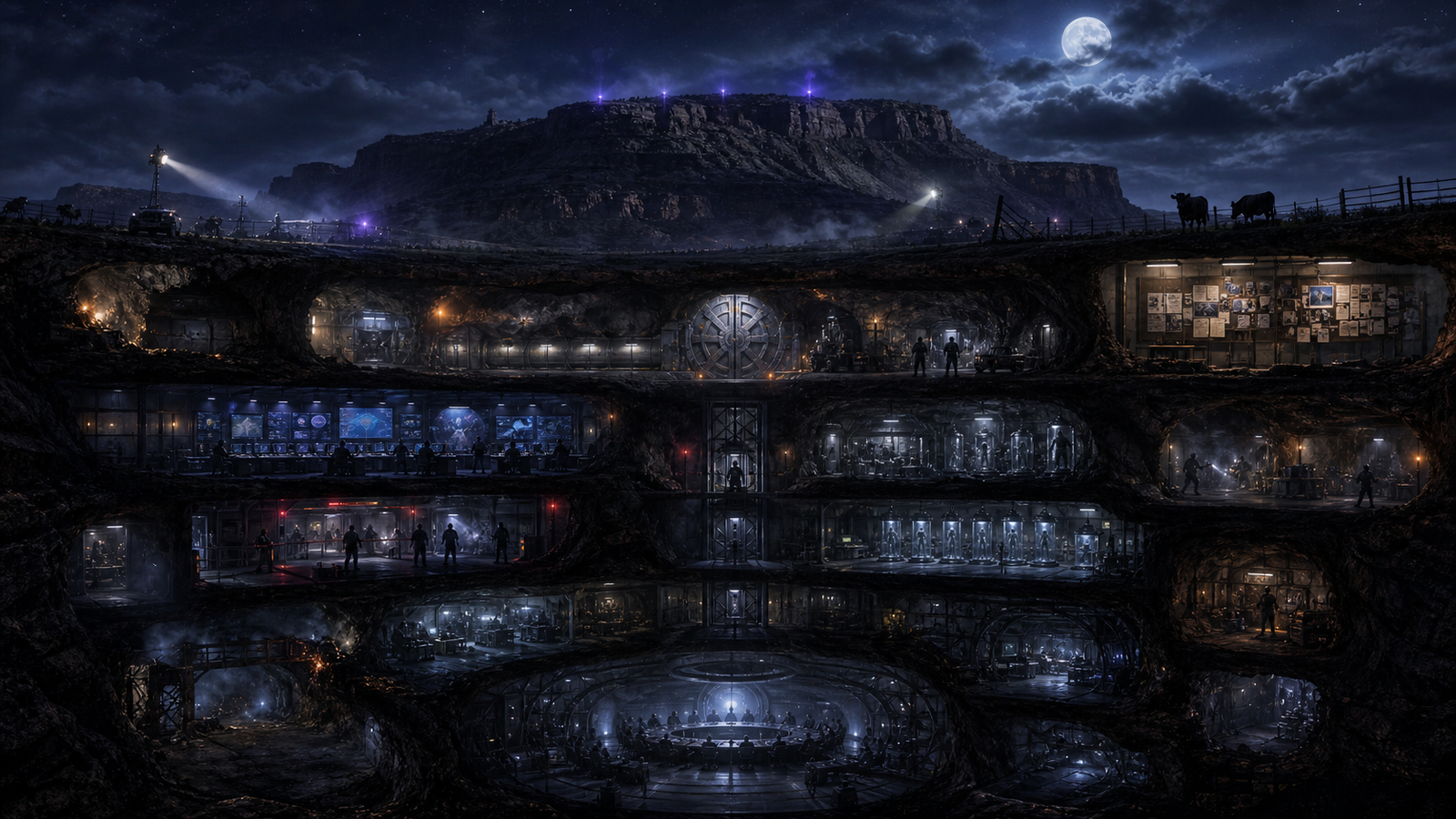
Archuleta Mesa Underground Alien War Theory
The Archuleta Mesa underground alien war story did not begin as a war story.
It began as a base story.
That distinction matters.
The earliest durable layer of the myth is the claim that something hidden existed beneath or near Archuleta Mesa outside Dulce, New Mexico. Only later did that hidden installation become a place of:
- treaty failure,
- biological experimentation,
- firefights,
- casualties,
- sealed sublevels,
- and an underground war between humans and nonhuman occupants.
That is how the legend escalated.
The strongest public record supports the existence of the myth, the role of Paul Bennewitz in early Dulce lore, and the later revelation that he was caught inside a documented disinformation environment. It does not support the historical demonstration of a real underground alien war beneath Archuleta Mesa.
What it supports is more revealing in another way: a clear example of how underground-base rumor, sincere belief, intelligence manipulation, and later sensational testimony can combine into one of the most vivid black-project myths in modern UFO culture.
Quick profile
- Topic type: conspiracy theory
- Core subject: how the Dulce Base rumor at Archuleta Mesa evolved into the “alien war” story
- Main historical setting: late 1970s through the 1990s, with a long afterlife in disclosure and underground-base culture
- Best interpretive lens: not “did a war happen,” but “how did the hidden-base story become a hidden-war story”
- Main warning: the conflict narrative is later and more extreme than the earliest Dulce claims
What this entry covers
This entry is the broadest headline page for the Archuleta Mesa war branch of the Dulce mythology.
It covers:
- why Archuleta Mesa became the geographic focus,
- how Paul Bennewitz seeded the early base claims,
- why Myrna Hansen and cattle-mutilation anxiety mattered,
- how Richard Doty and Bill Moore fit into the disinformation story,
- where the first “conflict” language appears,
- how John Lear expanded the theory,
- why Thomas Castello and Phil Schneider mattered to the later war narrative,
- and why the strongest public record still does not verify the battle itself.
That matters because many retellings flatten all of these phases into one seamless secret history. They were not one thing from the beginning.
The real ground: Archuleta Mesa and Dulce
Archuleta Mesa became the physical anchor of the story because it gave the mythology a real landform.
That matters.
A rumor is harder to sustain when it floats. A rumor tied to a visible mesa near a real town lasts longer. It gains:
- a horizon line,
- a direction,
- a location for lights in the sky,
- and a place onto which entrances, vents, shafts, and tunnel systems can be projected.
This is one reason the myth survives so well. It has geography.
The Mesa became, in effect, the lid over the story.
Paul Bennewitz and the first serious base claims
The modern Dulce mythology is inseparable from Paul Bennewitz.
He did not invent every later element, but he gave the story its early structure. Bennewitz believed he was intercepting unusual signals near Kirtland Air Force Base and became convinced that alien activity and installations were involved. Over time, his suspicions expanded toward northern New Mexico and what became known as Dulce Base.
That matters because the Archuleta Mesa story did not begin as campfire folklore. It began with someone who took his findings seriously, tried to engage authorities, and built a systems-level interpretation around what he thought he had discovered.
This gave the myth an investigative tone from the start.
Myrna Hansen, cattle mutilations, and underground imagery
Another early layer came from the broader panic around cattle mutilations and abduction-style testimony in the region.
The Myrna Hansen case mattered because it pushed the Dulce legend underground. Instead of only lights in the sky, the story now included:
- tunnels,
- examinations,
- vats,
- strange rooms,
- and a hidden installation beneath the surface.
That matters because the underground-war myth depends on prior underground architecture. You cannot have a battle under the mesa until the mythology has already built the rooms.
So Hansen-era material did not create the later firefight. But it helped create the subterranean interior in which the firefight could later be imagined.
The disinformation layer changed everything
One of the strongest documented facts in this entire history is that Bennewitz was fed disinformation.
This point is not a minor footnote. It is central.
Research into the Bennewitz affair, along with later public discussion of Bill Moore and Richard Doty, supports the conclusion that false or manipulated information circulated around Bennewitz at the very moment he was trying to make sense of what he thought he had found.
That matters because once disinformation enters the story, every later layer becomes harder to sort:
- what Bennewitz inferred himself,
- what he was encouraged to believe,
- what later writers embroidered,
- and what the culture preserved because it was too dramatic to discard.
This is why the Archuleta Mesa theory is so important historically. It is one of the clearest cases where myth and manipulation became entangled.
The first seed of the “war”
The fully cinematic war story came later. But a smaller seed appears earlier.
In Bennewitz's own writing, there are references to a dispute or conflict involving weapons and a base that was supposedly abandoned. This is not yet the full later Dulce War mythology. But it is a crucial transition point.
That matters because the story changes once conflict appears.
A hidden base can stay hidden for many reasons. A hidden war explains secrecy more powerfully. It implies:
- casualties,
- contamination,
- betrayal,
- operational failure,
- and reasons officials would never admit what happened.
This is the exact narrative energy that later writers exploited.
John Lear and the leap from rumor to system
The theory became much bigger once John Lear and other UFO-era amplifiers began repeating and expanding it.
That matters because Lear did not simply say there was something strange near Dulce. He helped locate the rumor inside a much larger cosmology involving:
- treaties,
- alien factions,
- underground systems,
- and clandestine government knowledge.
This is when the base story starts becoming a universe.
Once a story is inserted into a broader hidden-history system, it stops depending on direct evidence. It can survive by linking itself to everything else: Roswell, S-4, MJ-12, crash retrieval, and reverse engineering.
The Archuleta Mesa theory became stronger precisely because it was no longer required to stand alone.
Thomas Castello and the architecture of the hidden base
The next major escalation came with accounts attributed to Thomas Castello.
These claims are important not because they verify the base, but because they gave the mythology an extraordinary amount of interior detail.
Now the legend had:
- level-by-level descriptions,
- laboratories,
- cages,
- security systems,
- elevators,
- mixed human and alien occupancy,
- and specific imagery of biological experimentation.
That matters because detailed interiors make a rumor feel inhabitable.
This is the point where Archuleta Mesa stops being only a location and becomes an underground world.
Once that underground world exists in the imagination, it can support almost any later development, including a war story.
Phil Schneider and the full firefight narrative
The most famous and violent version of the theory is tied to Phil Schneider.
This is where the hidden-base rumor becomes the underground alien war in its most recognizable form.
Schneider's claims turned the story into a direct subterranean confrontation:
- tunnel boring,
- accidental breakthrough into an occupied zone,
- firefight with nonhuman beings,
- military casualties,
- and his own survival marked by injury.
That matters because Schneider gave the myth the one thing it had not yet fully possessed: a battlefield witness.
Whether the claim is historically verified is another matter. It is not. But in narrative terms, Schneider completed the transformation of the Dulce legend.
The base was no longer just there. It had fought back.
Why the war story spread so effectively
The alien-war version spread because it solved several problems at once.
1. It explained the secrecy
A hidden firefight is easier to imagine being buried than a passive underground installation.
2. It explained the danger
If people died below the mesa, silence begins to feel inevitable.
3. It explained the witnesses
Survivors, insiders, and security personnel suddenly make sense inside the story.
4. It explained the biology
The more grotesque lab imagery becomes easier to sustain if it is tied to hostile conflict.
5. It created escalation
A secret base is one level of secrecy. A secret war is another.
That combination made the theory unforgettable.
Why Archuleta Mesa worked so well as the setting
Archuleta Mesa works in conspiracy culture for the same reason Antarctica does in polar myths.
It feels:
- remote enough,
- elevated enough,
- closed enough,
- and visually dominant enough
to sustain the idea that something substantial could be hidden there.
It also helps that Dulce already carried regional anomaly folklore: lights, unusual sightings, and the residue of cattle-mutilation-era fear.
That matters because conspiracy locations do not need proof first. They need atmosphere first.
Archuleta Mesa had that atmosphere.
Local afterlife and cultural persistence
The story did not remain trapped in old UFO paperbacks. It persisted locally and culturally.
Dulce has repeatedly appeared in reporting about believers, conferences, tourism, and modern retellings of the base story. That matters because a myth becomes more durable when it is not only archived but lived around.
Local persistence does not prove the war. But it does explain why the theory still matters.
It remains part of the identity field around the place.
Why the theory keeps connecting to other black-project myths
The Archuleta Mesa war story became a bridge node because it connects naturally to so many other narratives.
It can be linked to:
- crash retrieval,
- biological experimentation,
- secret labs,
- underground facilities,
- reverse-engineering programs,
- treaty mythology,
- hostile nonhuman factions,
- and later breakaway-civilization theories.
That matters because the theory is not just about one alleged incident. It is about an entire hidden infrastructure of conflict.
Once that infrastructure exists, many other rumors can be routed through it.
Modern reinterpretations: from aliens to concealed terrestrial intelligences
In more recent speculative frameworks, the mesa story has also been absorbed into broader discussions of:
- underground nonhuman enclaves,
- cryptoterrestrials,
- hidden terrestrial intelligences,
- and secret base networks inside or beneath Earth.
That matters because the theory no longer depends entirely on the classic extraterrestrial script. It can survive by being translated into newer languages.
The shape of the myth stays the same: something lives below, something secret went wrong, and the truth was buried.
What the strongest public record actually supports
The strongest public record supports this narrower conclusion:
The Archuleta Mesa underground alien war theory is a later escalation of the broader Dulce Base mythology associated with northern New Mexico. The base story is historically traceable through Paul Bennewitz, cattle-mutilation and abduction-related lore, and the documented disinformation environment around Bennewitz involving figures such as Bill Moore and Richard Doty. Early conflict language appears in Bennewitz-era material, but the full firefight narrative was amplified later through writers and speakers such as John Lear, Thomas Castello, and especially Phil Schneider. The record strongly supports the history of the myth and its spread. It does not support the verified existence of a real underground alien war beneath Archuleta Mesa.
That is the right balance.
It preserves the theory's importance as conspiracy history without misrepresenting it as established fact.
Why this belongs in the black-projects section
This page belongs in declassified / black-projects because the Archuleta Mesa war story is not just a local ghost story.
It is a systems myth.
It connects:
- underground bases,
- reverse engineering,
- secrecy culture,
- intelligence manipulation,
- and hidden casualties.
That makes it one of the strongest connective nodes in the entire black-project conspiracy archive.
Why it matters in this encyclopedia
This entry matters because Archuleta Mesa Underground Alien War Theory explains how black-project myths intensify.
It is not only:
- a Dulce page,
- an underground-base page,
- or a Phil Schneider page.
It is also:
- a disinformation page,
- a hidden-war page,
- a treaty-failure page,
- and a mythology-escalation page.
That makes it indispensable for understanding how modern UFO conspiracy systems are built.
Frequently asked questions
Is the Archuleta Mesa underground alien war the same thing as Dulce Base?
It is best understood as a later, more violent branch of the broader Dulce Base mythology.
Did Paul Bennewitz originally claim there had been a war underground?
Not in the full later sense. Earlier material includes conflict-related ideas, but the detailed firefight narrative was amplified later.
Why are Richard Doty and Bill Moore important here?
Because the Bennewitz affair is one of the clearest documented examples of UFO-related disinformation feeding into a larger myth.
Did Thomas Castello prove the base existed?
No. His alleged accounts are important as part of the mythology record because they gave the base detailed internal structure, not because they provide verified proof.
Why is Phil Schneider so central to the story?
Because he turned the hidden-base rumor into a vivid underground battle narrative involving casualties and direct confrontation.
Is there verified evidence that a real battle happened under Archuleta Mesa?
No verified historical record demonstrates that a real underground alien war occurred there.
Why does the theory remain popular?
Because it combines secrecy, geography, biological horror, military conflict, witness testimony, and disinformation into a single high-intensity story.
Does local belief in Dulce prove the theory?
No. It does, however, help explain the theory's cultural longevity and symbolic power.
What is the strongest bottom line?
The Archuleta Mesa underground alien war is best understood as the most violent and fully developed form of the Dulce Base myth, shaped by genuine disinformation history and decades of escalating retellings rather than by verified proof of a subterranean battle.
Related pages
- Dulce Base Human-Alien Joint Lab Conspiracy
- S-4 Alien Biological Entity Program Theory
- S-4 Papoose Lake Alien Craft Storage Conspiracy
- Project Redlight Alleged Alien Craft Flight Test Program
- Project Snowbird Alleged Alien Craft Test Flight Program
- Project Sidekick Alleged Retro-Engineering Support Program
- Project Pounce Alleged UFO Debris Collection Program
- Project Blue Fly Alleged UFO Crash Retrieval Unit
- Project Moon Dust Alleged Foreign Spacecraft Recovery Program
- Skinwalker Ranch Underground Facility Conspiracy
- Mount Shasta Inner Earth Base Conspiracy
- Agartha Command Center Breakaway Civilization Theory
- Shambhala Hidden Advanced Base Conspiracy
- Antarctica Hidden Nazi Alien Base Conspiracy
- Groom Lake Underground City Black Project Conspiracy
- Black Projects
Suggested internal linking anchors
- Archuleta Mesa underground alien war theory
- Dulce war theory history
- Paul Bennewitz Dulce war
- Richard Doty Dulce disinformation
- Phil Schneider Dulce battle
- Thomas Castello Dulce base testimony
- underground alien war beneath Archuleta Mesa
- Dulce base firefight theory
References
- https://archive.org/details/projectbetastory0000bish
- https://www.cia.gov/readingroom/docs/CIA-RDP96-00792R000400300004-7.pdf
- https://www.wired.com/story/mirage-men/
- https://www.theguardian.com/film/2014/aug/14/men-in-black-ufo-sightings-mirage-makers-movie
- https://ia800808.us.archive.org/4/items/comparative-studies-in-religion-and-society-michael-barkun-a-culture-of-conspira/%28Comparative%20Studies%20in%20Religion%20and%20Society%29%20Mich%C3%A6l%20Barkun%20-%20A%20Culture%20of%20Conspiracy_%20Apocalyptic%20Visions%20in%20Contemporary%20America-University%20of%20California%20Press%20%282013%29.pdf
- https://books.google.com/books/about/Saucers_Spooks_and_Kooks.html?id=uuI9zgEACAAJ
- https://www.discovery.com/exploration/Secret-Underground-Alien-Base-Dulce-New-Mexico
- https://www.curatormagazine.com/lindsey-bright/archuleta-mesa-and-its-aliens/
- https://indianz.com/News/2016/05/10/jicarilla-apache-nation-draws-true-belie.asp
- https://www.koat.com/article/residents-of-dulce-claim-ufos-bigfoot-spotted-in-area-1/5071512
- https://static.foxnews.com/foxnews.com/content/uploads/2024/06/ThecryptoterrestrialhypothesisLomasetal.J2024.pdf
- https://www.aaro.mil/Portals/136/PDFs/AARO_Historical_Record_Report_Vol_1_2024.pdf
- https://www.bibliotecapleyades.net/branton/esp_dulcebook11.htm
- https://archive.org/details/youtube-v6kTODsqbDI
Editorial note
This entry treats the Archuleta Mesa underground alien war as the point where the Dulce myth reached maximum intensity.
That is the right way to read it.
The earliest parts of the Dulce story are already strange: Bennewitz, intercepted signals, underground installations, cattle-mutilation fear, abduction-style imagery, and increasing paranoia in a region already primed for anomaly stories. But the later war version goes further. It turns hidden infrastructure into hidden conflict. It says something not only secret but violent happened below the mesa. That is why the story stayed alive. Conflict gives secrecy emotional force. It also gives later witnesses and text fragments a dramatic place to attach themselves. The result was a theory that could connect abductions, biological labs, treaty mythology, reverse engineering, casualties, and intelligence disinformation in one underground setting. The strongest historical record supports the making of that mythology. It does not support the existence of the war itself.