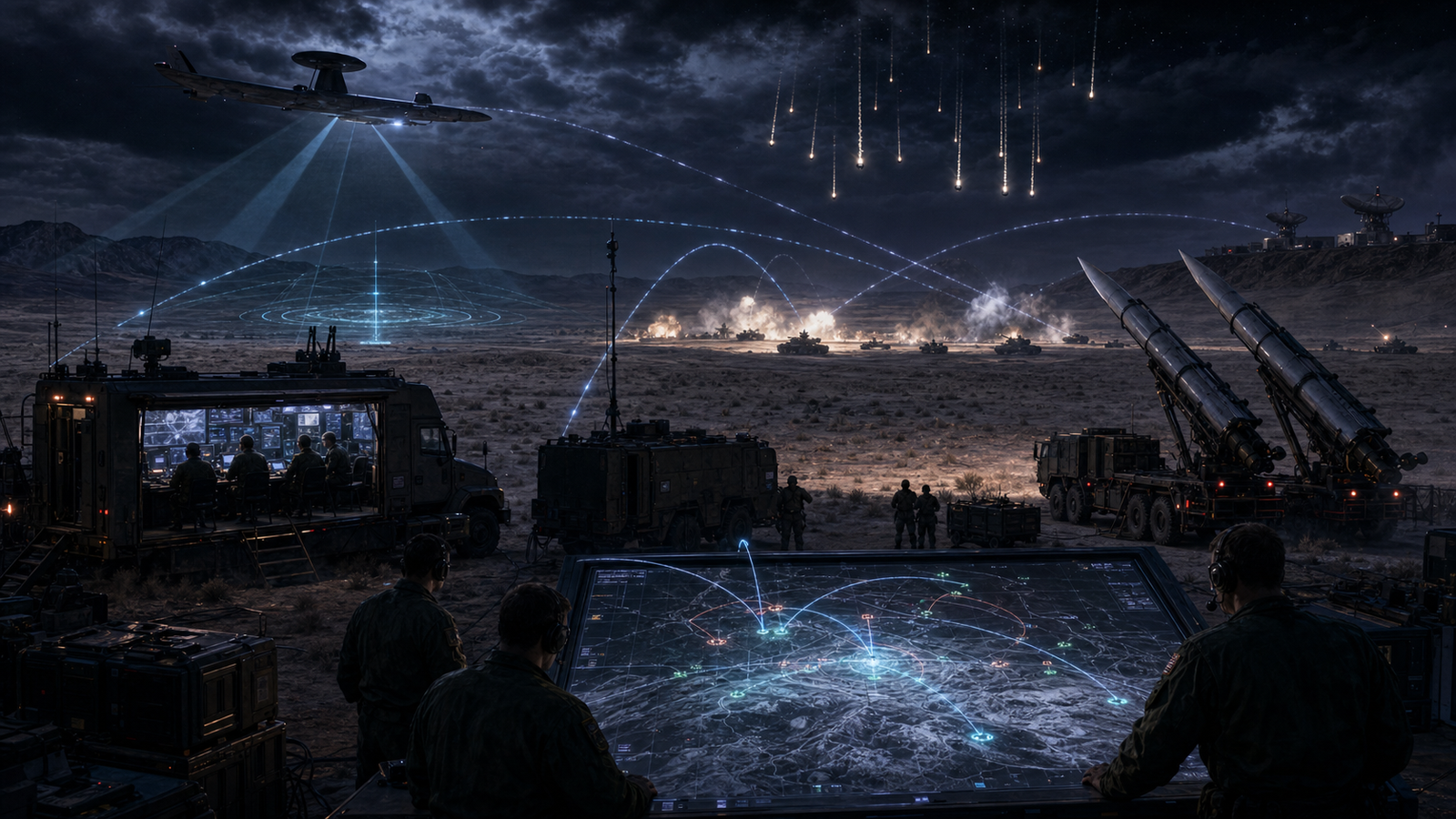
Assault Breaker Deep Strike Networked Weapons Program
Assault Breaker mattered because it treated deep strike as a network problem.
That is the key to the entire program.
The goal was not simply to build a better missile. It was not simply to build a better radar. It was to connect:
- detection,
- processing,
- command,
- transmission,
- launch,
- and terminal attack
fast enough that moving armored forces behind the front could be found and hit before they changed the battle.
That was a radical shift.
In older terms, deep attack often meant penetrating aircraft, delayed target cycles, or nuclear weapons held in reserve for the worst case. Assault Breaker offered another possibility: a conventional, networked, near-real-time system able to see deep and shoot deep.
That is why the program belongs in any serious black-projects archive. It was one of the clearest late Cold War demonstrations that modern warfare would increasingly be decided not by one platform, but by how tightly sensors and shooters could be linked.
Quick profile
- Topic type: historical record
- Core subject: how Assault Breaker fused radar, processing, communications, and guided munitions into an early deep-strike battle network
- Main historical setting: late 1970s through early 1980s, with major legacy into later JSTARS-era precision warfare
- Best interpretive lens: not “what weapon was Assault Breaker,” but “how did this program prove that conventional deep strike could become a networked timing system”
- Main warning: Assault Breaker was historically decisive as a demonstration and transition effort, even though it was not fielded intact as one single standalone system
What this entry covers
This entry is the headline page for the Assault Breaker cluster in the black-projects archive.
It covers:
- why late Cold War planners wanted a conventional answer to massed armored follow-on forces,
- why DARPA integrated the program in 1978,
- how Pave Mover mattered,
- why the attack coordination center was so important,
- how Army and Air Force roles overlapped and competed,
- what the 1981–82 demonstrations proved,
- why procurement and management became complicated,
- and how the program's legacy outlived the exact system.
That matters because Assault Breaker is often remembered as an anti-tank smart-weapon story. It was much bigger than that.
It was an early working model of what later generations would call a sensor-to-shooter network or an operational battle network.
The problem it was built to solve
Assault Breaker emerged because NATO planners feared that large Warsaw Pact armored formations would continue moving behind the forward battle area even after the first line of fighting had been engaged.
That is the origin problem.
If those follow-on forces could not be disrupted quickly, a breakthrough at the front could be exploited by large reinforcements moving behind it. The traditional answers involved either risky aircraft penetration or nuclear escalation.
That mattered because those options were unsatisfying. Assault Breaker represented an attempt to build a conventional alternative: find moving armored forces deep in the rear and hit them before they could become decisive.
This is why the phrase follow-on forces attack matters so much to the story. It is the doctrinal frame that made Assault Breaker necessary.
Why DARPA mattered so much
The program mattered because DARPA did not approach it as one isolated hardware purchase.
DARPA integrated technologies that were already maturing separately:
- airborne moving-target radar,
- synthetic aperture radar,
- processors,
- communications links,
- missile delivery systems,
- and terminally guided anti-armor submunitions.
That matters because the historical breakthrough was not that any single component was impossible before. The breakthrough was that the components were finally treated as parts of one timed architecture.
In 1978, DARPA formally brought these technologies together under the Assault Breaker effort. That decision is one of the most important moments in the history of modern deep strike.
Why Pave Mover was indispensable
No part of Assault Breaker makes sense without Pave Mover.
The program required a way to detect and track moving targets deep behind the line. That is what the radar lineage provided.
Pave Mover built on earlier moving-target indication research and added synthetic aperture radar capability for analyzing areas where pure moving-target tracking was not enough. That mattered because deep strike is useless if the target has already shifted before the weapon arrives.
So while submunitions get much of the visual attention, the real strategic heart of Assault Breaker was the sensor problem. Pave Mover was the reason the rest of the strike chain could become operationally meaningful.
This is also why the most enduring lineage of Assault Breaker runs through JSTARS.
The attack coordination center: the hidden core of the concept
One of the most important but least glamorous parts of Assault Breaker was the ground-based data processing and attack coordination function.
That piece matters because a radar track is not yet a strike. It has to be:
- processed,
- interpreted,
- matched to a target set,
- assigned to a shooter,
- and transmitted fast enough to remain useful.
The coordination center turned the idea from technology collection into a battle network.
This is one reason Assault Breaker still feels modern. It was not just about finding targets and launching weapons. It was about compressing the kill chain into something approaching operational tempo.
That is where much of its historical importance lies.
Air Force and Army roles made the program bigger—and harder
Assault Breaker also mattered because it cut across traditional service lines.
The Army wanted a ground-launched strike option. The Air Force wanted an air-launched version and had major stakes in the radar side of the system. GAO reporting from 1981 makes clear that service-management questions were central to the program's future.
That matters because the concept was too large to fit neatly inside one service's existing boundaries.
The Army looked toward a Corps Support Weapon System replacement path. The Air Force looked at aircraft delivery, including B-52-related options for missile launch. Both needed the radar and targeting network to make the concept meaningful.
This is one reason the program is historically important. It was a real test of whether joint deep strike could be built before the modern joint-command culture was fully mature.
The smart submunition logic
Assault Breaker is often described as a missile program, but that is only partly right.
The strike package depended heavily on terminally guided submunitions. Instead of relying on one warhead to hit a single aimpoint, the system aimed to disperse smart submunitions over armored formations and let them search, sort, and attack effectively.
That mattered because massed armor is a formation problem. The strike concept matched that logic.
The program explored multiple contractors, missile approaches, and submunition designs. Some pieces worked better than others. But the larger point remained intact: conventional guided munitions could threaten moving armored concentrations at operational depth once the targeting network was good enough.
What the demonstrations actually proved
Testing began in 1979, and integrated demonstrations followed in 1981–82.
This matters because the demonstrations were not simply laboratory events. They were efforts to prove that the entire chain could work in sequence:
- moving target detection,
- targeting data transmission,
- missile guidance,
- and submunition delivery onto relevant armored targets.
The program demonstrated on a small scale that tanks located far beyond the immediate front could be located and struck through a coordinated network using conventional munitions. That is the decisive historical fact.
Even if the exact final fielded “Assault Breaker system” never appeared as one single procurement package, the concept had crossed the threshold from idea to proof.
That is why historians keep returning to it.
Why GAO raised hard questions
The program also mattered because its promise created immediate acquisition pressure.
GAO's 1981 report shows that major decisions still remained unresolved:
- whether the concept had been tested enough,
- how cost-effective it would be against alternatives,
- how responsibilities should be divided,
- and how a cross-service acquisition effort should be managed.
That matters because big systems-integration successes often create a second problem: who owns the future?
Assault Breaker was advanced enough to excite planners, but not mature enough to make organizational questions disappear. That tension is part of the program's real history.
Why Assault Breaker was historically larger than its exact procurement outcome
This point matters more than it first appears.
A narrow reading asks: was Assault Breaker fielded exactly as designed?
A better reading asks: did Assault Breaker permanently alter how the U.S. military thought about deep strike?
The answer to the second question is clearly yes.
The program showed that conventional forces could use tightly linked sensors and smart munitions to threaten follow-on formations once thought reachable only by much riskier or more escalatory means. That shifted doctrine, research priorities, and perceptions of what battle networks could do.
So Assault Breaker should not be judged only as a procurement package. It should be judged as a historical turning point.
Pave Mover to JSTARS: the clearest legacy
The most obvious and durable legacy of Assault Breaker is JSTARS.
DARPA's own JSTARS timeline makes the lineage explicit: Pave Mover, developed under Assault Breaker, fed directly into what later became the Joint Surveillance Target Attack Radar System. That matters because JSTARS made one part of the old deep-strike architecture operational and visible.
It also shows how these histories really work.
The original integrated concept does not always survive unchanged. Instead, its most successful components migrate into later systems that become indispensable in their own right.
That is exactly what happened here.
Why later analysts call it an “operational battle network”
Modern analysts often describe Assault Breaker as an early operational battle network.
That phrasing is useful because it captures the real achievement better than older single-weapon labels do. The system was a network:
- sensor,
- processor,
- transmitter,
- launcher,
- munition,
- and target-discrimination logic.
That matters because modern military language about kill webs, battle networks, and joint all-domain coordination can sound entirely new. Assault Breaker is a reminder that the core logic is older.
The late 1970s and early 1980s had already begun to show what such a network might look like.
Soviet reactions and the reputation of the program
Part of Assault Breaker's reputation comes from how analysts later described Soviet responses to emerging U.S. precision-strike capabilities.
Strategic studies and retrospective writing argue that the Soviet military took the implications seriously, especially once reconnaissance-and-strike or reconnaissance-strike-complex ideas became more prominent. That matters because Assault Breaker was not remembered only as an American experiment. It became part of a wider story about how precision-guided conventional weapons could alter strategic calculations.
Even when such claims are remembered in simplified form, they reflect a real perception shift: conventional precision, when networked, could start to challenge mass in ways earlier planners had not treated as feasible.
Why the program still matters now
Assault Breaker still matters because it feels so contemporary.
Its core logic remains recognizable:
- detect mobile targets,
- fuse data rapidly,
- assign the right shooter,
- use smart weapons,
- and collapse the timeline between sensing and attack.
That is still the modern problem.
The technologies have changed. The architecture has grown more distributed. But the basic operational dream is the same. In that sense, Assault Breaker belongs not only to Cold War history but to the long prehistory of present-day battle-network thinking.
What the strongest public record actually supports
The strongest public record supports this narrower conclusion:
Assault Breaker was a real DARPA-led deep-strike systems-integration program that began in 1978 and demonstrated, by 1981–82, that airborne radar, data processing, communications links, missiles, and guided anti-armor submunitions could be combined into a near-real-time conventional strike architecture against moving rear-echelon targets. The exact system was not fielded intact as one standalone operational package, and service-management questions complicated its transition. But the program decisively influenced later capabilities, especially the Pave Mover-to-JSTARS lineage and the broader logic of operational battle networks and precision deep strike.
That is the right balance.
It preserves the scale of the achievement without pretending the history was simpler than it was.
Why this belongs in the black-projects section
This page belongs in declassified / black-projects because Assault Breaker sits at the junction of:
- advanced sensors,
- guided weapons,
- cross-service integration,
- and late Cold War conventional deterrence.
It is not a fringe story. It is a foundational systems-history page for how classified and semi-classified development efforts helped produce later visible operational capabilities.
That makes it essential to the archive.
Why it matters in this encyclopedia
This entry matters because Assault Breaker Deep Strike Networked Weapons Program explains how battle-network warfare started to become real.
It is not only:
- a missile page,
- a radar page,
- or a DARPA page.
It is also:
- a timing page,
- a systems-integration page,
- a doctrine page,
- and a precision-strike origins page.
That makes it one of the most important entries in the black-projects technology lineage.
Frequently asked questions
What was Assault Breaker?
Assault Breaker was a DARPA-led late Cold War program that integrated airborne radar, data processing, communications, missiles, and smart anti-armor submunitions for deep strike against moving armored forces.
Was Assault Breaker a single weapon?
No. It is best understood as a systems-of-systems or battle-network concept rather than one single missile or one single aircraft.
Why is Pave Mover so central to the story?
Because deep strike against moving targets depends on timely detection and tracking. Pave Mover provided the radar logic that made the rest of the network meaningful.
Did Assault Breaker become JSTARS?
Not directly as a whole system, but the Pave Mover radar lineage under Assault Breaker fed into JSTARS, which became the clearest operational legacy.
Was Assault Breaker fielded exactly as designed?
No. The concept was demonstrated and transitioned unevenly rather than fielded intact as one single standalone system.
Why did GAO question the program?
Because cost, testing sufficiency, management, and service responsibilities were still unresolved as the program moved from demonstration toward possible acquisition.
Why is Assault Breaker considered historically important?
Because it proved that conventional precision strike could become strategically significant once sensors and shooters were linked tightly enough in near-real time.
Is this part of the “offset strategy” story?
Yes. Assault Breaker is often treated as one of the most important practical demonstrations of the late Cold War precision-strike logic associated with the offset strategy tradition.
What is the strongest bottom line?
Assault Breaker mattered because it showed that modern deep strike was fundamentally a network problem, and that once the network worked, conventional guided weapons could begin to do things previously associated with far riskier or more escalatory options.
Related pages
- Pave Mover Battlefield Surveillance Radar Program
- TEAL RUBY Space-Based Missile Tracking Program
- TACIT RAINBOW Anti-Radar Stealth Missile Program
- TACIT BLUE Low Observable Radar Aircraft Program
- BSAX Tacit Blue Stealth Surveillance Aircraft Program
- Advanced Technology Bomber B-2 Black Program
- Bird of Prey Experimental Stealth Aircraft Program
- DarkStar Stealth UAV Black Aircraft Program
- Project QUILL Radar Imaging Satellite Program
- Project MIDAS Missile Warning Satellite Program
- Project SAINT Satellite Inspector Black Program
- Black Projects
Suggested internal linking anchors
- Assault Breaker deep strike networked weapons program
- Assault Breaker program history
- DARPA Assault Breaker Pave Mover JSTARS
- Assault Breaker battle network history
- Assault Breaker follow on forces attack
- Assault Breaker precision strike program
- Pave Mover battlefield surveillance radar history
- early operational battle network history
References
- https://www.darpa.mil/about/innovation-timeline/assault-breaker
- https://www.darpa.mil/about/innovation-timeline/jstars
- https://www.gao.gov/assets/masad-81-9.pdf
- https://dsb.cto.mil/wp-content/uploads/reports/2010s/LRE%20Executive%20Summary__Final.pdf
- https://www.files.ethz.ch/isn/168276/Evolution-of-Precision-Strike-final-v15.pdf
- https://warontherocks.com/2014/11/the-cold-war-offset-strategy-assault-breaker-and-the-beginning-of-the-rsta-revolution/
- https://www.cnas.org/publications/reports/beating-the-americans-at-their-own-game
- https://books.openbookpublishers.com/10.11647/obp.0184/ch8.xhtml
- https://www.airandspaceforces.com/PDF/MagazineArchive/Documents/2016/July%202016/0716secondoffset.pdf
- https://www.darpa.mil/about/innovation-timeline/brilliant-anti-tank-munition
- https://history.army.mil/portals/143/Images/Publications/catalog/69-5-1.pdf
- https://www.esd.whs.mil/Portals/54/Documents/FOID/Reading%20Room/DARPA/15-F-1407_BREAKTHROUGH_TECHNOLOGIES_MAR_2015-DARPA.pdf
- https://www.airuniversity.af.edu/Portals/10/AUPress/Books/B_0050_MORTENSEN_AIRPOWER_GROUND_ARMIES.pdf
- https://www.war.gov/News/%20Speeches/Speech-View/Article/606641/the-third-us-offset-strategy-and-its-implications-for-partners-and-allies/
Editorial note
This entry treats Assault Breaker as one of the most important pre-digital-age demonstrations of networked conventional warfare.
That is the right way to read it.
The program is often remembered through whatever single piece a reader already knows best: smart submunitions, Pave Mover, JSTARS, the offset strategy, or follow-on forces attack. But Assault Breaker only becomes fully visible when those pieces are viewed together. Its achievement was integration under time pressure. It connected moving-target detection, processing, communication, launch, and terminal attack tightly enough to prove that conventional deep strike could be organized as a coordinated battle network rather than left to isolated platforms acting on stale information. The exact system did not survive unchanged as one fielded package, and service politics complicated its transition. But that does not reduce its importance. It clarifies it. Assault Breaker mattered because it showed how the logic of modern precision warfare would actually work.