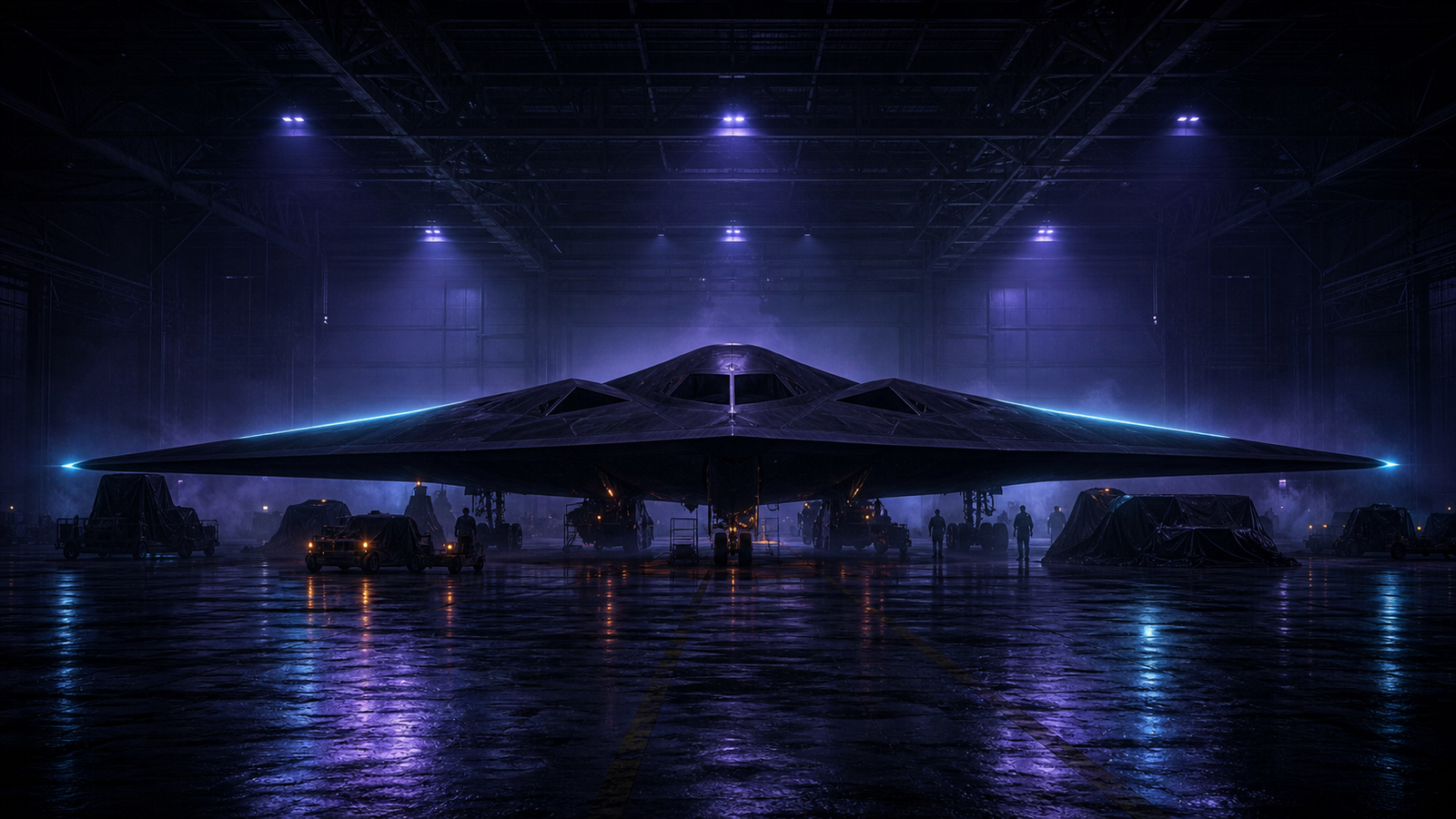
Advanced Technology Bomber B-2 Black Program
The B-2 did not become legendary because it was merely secret.
It became legendary because it was strategic stealth made real.
Earlier low-observable projects proved that aircraft could be made harder to detect. The B-2 tried something larger, riskier, and more expensive: to turn stealth into a long-range bomber doctrine.
That is what made the Advanced Technology Bomber so important.
This was not just an aircraft program. It was a test of whether the United States could build a bomber that combined:
- low observability,
- intercontinental reach,
- meaningful payload,
- and survivability against sophisticated defenses,
without relying on raw speed in the older sense.
That is why the B-2 belongs at the center of any serious black-projects archive. It was one of the clearest moments when the hidden world of low-observable design became a public military fact.
Quick profile
- Topic type: historical record
- Core subject: how the Advanced Technology Bomber became the B-2 Spirit and redefined strategic stealth
- Main historical setting: late Cold War stealth development through rollout, procurement conflict, and early combat use
- Best interpretive lens: not simply “what is the B-2,” but “why did this bomber become the defining strategic black program of the stealth era”
- Main warning: the B-2 was never just a shape or a symbol; it was a deeply political, doctrinal, and industrial project
What this entry covers
This entry is the headline black-projects page for the Advanced Technology Bomber B-2 cluster.
It covers:
- why the ATB mattered in the late Cold War,
- how the B-2 emerged from the stealth revolution,
- why the flying-wing design returned,
- what made the bomber different from earlier stealth aircraft,
- why the program became so controversial,
- how block upgrades mattered,
- how Kosovo helped validate the concept,
- and why the B-2 remains one of the most iconic black-budget aircraft ever built.
That matters because the B-2 is often discussed as if it were only an exotic silhouette. Its real importance is much larger than that.
The aircraft represented a strategic wager: that survivability through low observability could justify vast cost, deep secrecy, and a new style of penetration warfare.
Why the Advanced Technology Bomber mattered
The Advanced Technology Bomber mattered because it shifted stealth from a specialized tactical tool into a strategic force concept.
That is the central point.
A stealth fighter can slip through defenses for a limited mission. A stealth bomber aims to do something broader: carry large effects over long distances and threaten heavily defended targets at the start of a campaign.
That changed the scale of the question.
The B-2 was not asked merely to survive. It was asked to remain relevant at the highest levels of deterrence and war planning.
That is why the black-program aura around it remained so strong even after public rollout. The aircraft did not just embody secret engineering. It embodied secret assumptions about how future wars would begin.
From stealth demonstrators to strategic stealth
The B-2 did not appear out of nowhere.
It belongs to the same larger low-observable lineage that includes HAVE BLUE, SENIOR TREND, and TACIT BLUE. Those programs helped establish that signature reduction could change what an aircraft could do against dense air defenses. But the B-2 translated that lesson into a much more demanding mission set.
That matters because the B-2 should not be read as a giant F-117.
It was a different category of problem.
The B-2 needed:
- longer reach,
- larger payload,
- strategic relevance,
- and a design language that could support survivability without sacrificing the aerodynamic advantages needed for global operations.
This is one reason the aircraft remains so historically important. It marked the point where stealth stopped being a narrowly hidden breakthrough and became a cornerstone of long-range strike planning.
Why the flying wing returned
The B-2 became visually iconic because its form looked almost unreal. But the shape was not chosen for spectacle.
It was chosen because the flying wing offered a way to merge low observability, aerodynamic efficiency, and internal volume.
That matters because the aircraft’s appearance was not decorative. It was mission logic made visible.
The public tends to remember the B-2 as a black boomerang. A more accurate reading is that the bomber’s shape reflects an effort to reduce signatures while preserving range and payload.
That is where the B-2 becomes more than an image. It becomes a systems answer to a strategic problem.
Why the program stayed a black project for so long
The B-2 carried a deep black-program identity because its value depended heavily on what adversaries did not know.
A stealth bomber does not gain its advantage only from existing. It gains advantage from uncertainty around:
- how it appears to sensors,
- how it is best tracked,
- what routes it can tolerate,
- how it behaves in defended airspace,
- and how much warning an opponent really has.
That matters because public visibility did not end secrecy. It only changed the layer of secrecy.
The airframe became visible. The most meaningful survivability logic did not.
This is one of the defining features of mature black programs: the hardware can be acknowledged while the most important operational truths remain partly buried.
Rollout, first flight, and the controlled reveal
The B-2 became publicly visible in stages, but even the reveal felt controlled and symbolic.
The aircraft was publicly rolled out in 1988, first flew in 1989, and the first operational aircraft reached Whiteman Air Force Base in 1993. Those dates matter because they show the transition from hidden development to operational institution.
This was the moment when the Advanced Technology Bomber stopped being an abstract classified idea and became a real military object around which doctrine, budgets, expectations, and criticism could gather.
That is how black programs become historically legible: not only through declassification, but through delivery, basing, and sustained use.
What made the B-2 different from earlier stealth aircraft
The B-2 mattered because it fused together things that earlier stealth aircraft did not combine at the same scale.
It joined:
- low observability,
- long range,
- heavy payload,
- strategic mission value,
- and manned flexibility.
That combination is the key.
The B-2 was not just hard to detect. It was designed to do consequential work after penetrating.
That made it fundamentally different from reading stealth as a narrow technical trick. The B-2 made stealth operational at bomber scale.
It also made the aircraft expensive in every sense: financially, industrially, politically, and conceptually.
The procurement shock
One reason the B-2 became famous outside aviation circles is simple: the program was enormously controversial.
The Air Force originally pursued a much larger fleet, but the planned quantity was cut sharply as the Cold War ended and the aircraft’s cost remained a central political issue. GAO reporting documented the scale of the cost challenge and the complexity of delivering a fully operational fleet.
That matters because the B-2’s reputation was shaped by two kinds of shock at once.
The first was visual shock. It looked like a machine from a future that had arrived too early.
The second was budget shock. It became one of the clearest symbols of how expensive strategic stealth could become once research, development, production, infrastructure, and upgrades were counted together.
This is why cost is not a side story. It is part of the B-2’s identity as a black project.
Block 10, 20, and 30: the hidden reality of “fielding” the aircraft
The public often imagines that once an aircraft is built, it is simply finished.
The B-2 story is a reminder that black programs are rarely that simple.
GAO reporting shows that the B-2 fleet moved through block 10, block 20, and block 30 configurations, with earlier aircraft accepted before the final full-capability configuration was complete. That matters because it reveals the real structure of advanced military fielding: development, testing, production, and modification overlapped.
So the B-2 was not a single clean achievement. It was a rolling process of completion.
That helps explain both the program’s cost and its political vulnerability. The aircraft existed, but the argument over what exactly had been bought, what remained unfinished, and what further upgrades were necessary did not disappear.
Why the B-2 became politically radioactive
The B-2 became politically charged because it sat at the intersection of three hard questions:
1. Could strategic stealth justify its cost?
That was the procurement question.
2. Was the bomber still optimized for a world that was changing?
That was the post-Cold War question.
3. How much could the public evaluate if the most important details remained classified?
That was the black-program question.
Those three questions gave the B-2 a strange kind of fame. It became not only a bomber, but a referendum on what the United States was willing to spend for survivability in the opening phase of a major war.
Kosovo and the proof of concept
The B-2’s first combat use mattered so much because it tested whether the strategic stealth idea could survive outside theory.
In Operation Allied Force, B-2s flew long missions from Whiteman to strike targets tied to the air campaign over Serbia and Kosovo. Official Air Force material later emphasized that the aircraft accounted for an outsized portion of early target destruction despite flying only a small fraction of total sorties.
That matters because black programs become durable legends when they cross from promise into performance.
Kosovo did not answer every criticism. But it gave the B-2 something procurement debates alone could never provide: an operational story.
That story helped stabilize the aircraft’s reputation. The B-2 was no longer only a black-budget gamble. It had become a bomber with a combat record.
Afghanistan and Iraq deepened the reputation
After Kosovo, the B-2’s image as a first-night or early-phase strategic penetrator strengthened further.
Its long-duration missions, its use in major campaigns after 2001, and the persistence of its role in both nuclear and conventional strike reinforced the aircraft’s identity as something more than a late Cold War relic.
That matters because many expensive strategic systems lose historical weight after the threat environment changes.
The B-2 did not vanish that way.
Instead, it was adapted into the post-Cold War world and remained a powerful symbol of survivable long-range strike.
Why the B-2 became one of the defining black projects
The B-2 became one of the defining black projects because it concentrated nearly every major feature that gives black programs their lasting aura:
1. A radical silhouette
The aircraft looked unlike conventional bombers and instantly suggested hidden engineering logic.
2. Persistent classification
The bomber was public, but many of the most meaningful low-observable details remained classified.
3. Extraordinary cost
The price of the program made it impossible to treat as a niche experiment.
4. Strategic relevance
This was not a test article. It was meant for the opening phases of major war.
5. Operational validation
Combat use helped convert a controversial procurement into a historically grounded capability.
That combination is rare. Many black programs are secret but small. Others are expensive but forgettable. The B-2 became iconic because it was secret, strategic, expensive, visually unforgettable, and operationally real.
What the strongest public record supports
The strongest public record supports this narrower conclusion:
The Advanced Technology Bomber became the B-2 Spirit as the strategic-scale expression of the American low-observable revolution. It was designed to combine stealth, range, and payload in a flying-wing bomber that could penetrate sophisticated defenses and deliver conventional or nuclear weapons with enhanced survivability. The program was real, historically central, and operationally proven. Its public history is also inseparable from cost controversy, block-by-block maturation, and the fact that many of its deepest survivability details remain classified even after decades of service.
That is the right balance.
It preserves the program’s importance without turning it into fantasy. And it preserves the role of secrecy without pretending the aircraft is unknowable.
Why this belongs in the black-projects section
This page belongs in declassified / black-projects because the B-2 is not just an aircraft entry.
It is a foundational black-program systems page.
It connects:
- stealth development,
- procurement conflict,
- strategic doctrine,
- industrial scale,
- and operational proof.
It also works as a bridge node between earlier stealth entries and later low-observable systems. That makes it ideal for the kind of relationship-based archive you are building.
Why it matters in this encyclopedia
This entry matters because Advanced Technology Bomber B-2 Black Program explains what happens when the hidden logic of stealth is scaled up to strategic consequence.
It is not only:
- a B-2 page,
- a bomber page,
- or a stealth page.
It is also:
- a doctrine page,
- a procurement page,
- a design page,
- and a black-budget page.
That makes it one of the central pieces of any serious declassified aerospace archive.
Frequently asked questions
Was the B-2 really a black program?
Yes. The Advanced Technology Bomber developed within the black-project world of low-observable aerospace programs, even though the aircraft was eventually rolled out publicly.
Why is it called the Advanced Technology Bomber?
Because before it became publicly known as the B-2 Spirit, it was pursued as the Advanced Technology Bomber, or ATB, a strategic stealth bomber concept built around survivability through low observability.
What made the B-2 different from earlier stealth aircraft?
It combined stealth with strategic range and heavy payload. That made it a bomber-scale penetration system rather than a narrower tactical stealth platform.
Why did the B-2 use a flying-wing design?
Because the flying wing helped merge aerodynamic efficiency, internal volume, and low-observable shaping in a way that supported the bomber’s mission.
Why was the program so controversial?
Because it was extraordinarily expensive, deeply classified in key areas, and pursued at a scale that forced Congress and the public to confront the cost of strategic stealth.
How many B-2s were ultimately built?
The public historical record shows the fleet ended far below the much larger early plan, with the program settling into a very small operational force.
Did the B-2 prove itself in combat?
Yes. Kosovo was its first combat use, and later operations in Afghanistan and Iraq reinforced its role as a long-range penetrating strike platform.
Why does the B-2 still feel like a black project even though everyone knows what it is?
Because public acknowledgment does not reveal every important detail. The airframe is visible, but many key survivability and mission-system truths remain partly classified.
Is the B-2 more important as technology or doctrine?
Both, but doctrine is the reason the technology mattered. The aircraft was built to change how defended targets could be struck, especially in the opening phase of conflict.
What is the strongest bottom line?
The B-2 became iconic because it turned stealth from a hidden technical breakthrough into a strategic bomber reality, while carrying all the secrecy, controversy, and consequence that such a transition would inevitably create.
Related pages
- HAVE BLUE Stealth Demonstrator Black Project
- SENIOR TREND F-117 Stealth Fighter Black Program
- TACIT BLUE Low Observable Radar Aircraft Program
- BSAX Tacit Blue Stealth Surveillance Aircraft Program
- SENIOR CITIZEN Advanced Stealth Bomber Study
- Bird of Prey Experimental Stealth Aircraft Program
- TACIT RAINBOW Anti-Radar Stealth Missile Program
- DarkStar Stealth UAV Black Aircraft Program
- Sea Shadow Stealth Warship Black Program
- Project OXCART A-12 CIA Mach 3 Reconnaissance Program
- Project ARCHANGEL A-12 Black Aircraft Design Program
- Black Projects
Suggested internal linking anchors
- Advanced Technology Bomber B-2 black program
- ATB black program history
- B-2 stealth bomber black project
- B-2 flying wing stealth history
- B-2 procurement controversy
- Northrop Advanced Technology Bomber
- B-2 low observable bomber program
- strategic stealth bomber history
References
- U.S. Air Force - B-2 Spirit Fact Sheet
- National Museum of the U.S. Air Force - Northrop B-2 Spirit
- Northrop Grumman - B-2 Spirit Stealth Bomber
- Northrop Grumman - B-2 Technical Details
- Northrop Grumman - Our Heritage
- Northrop Grumman - 10 Cool Facts about the B-2
- GAO - B-2 Bomber: Status of Efforts to Acquire 21 Operational Aircraft
- GAO - B-2 Bomber: Status of Cost, Development, and Production
- GAO - B-2 Bomber: Cost and Operational Issues
- Whiteman Air Force Base - B-2 Spirit Fact Sheet
- Whiteman Air Force Base - History
- Air Force Historical Support Division - 1999 Operation Allied Force
- Wright-Patterson AFB - B-2 Spirit Marks 30th Anniversary of First Flight
- Air & Space Forces Magazine - History of Stealth: From Out of the Shadows
Editorial note
This entry treats the Advanced Technology Bomber as the point where stealth stopped being primarily a hidden breakthrough and became a strategic military structure.
That is the right way to read the B-2.
The aircraft is often remembered through its shape alone, but shape was only the public face of a much larger wager. The real question behind the program was whether low observability could be scaled into an aircraft with bomber-level range, payload, and strategic importance. The answer, at least in the strongest public record, is yes — but at immense cost, under deep secrecy, and with years of political argument over how many aircraft the United States was willing to buy to preserve that advantage. That is why the B-2 became more than an advanced bomber. It became one of the clearest black-project symbols of the late Cold War and its aftermath: a machine that made stealth strategic, made procurement painful, and made the invisible geometry of first-night war planning visible to the entire world.