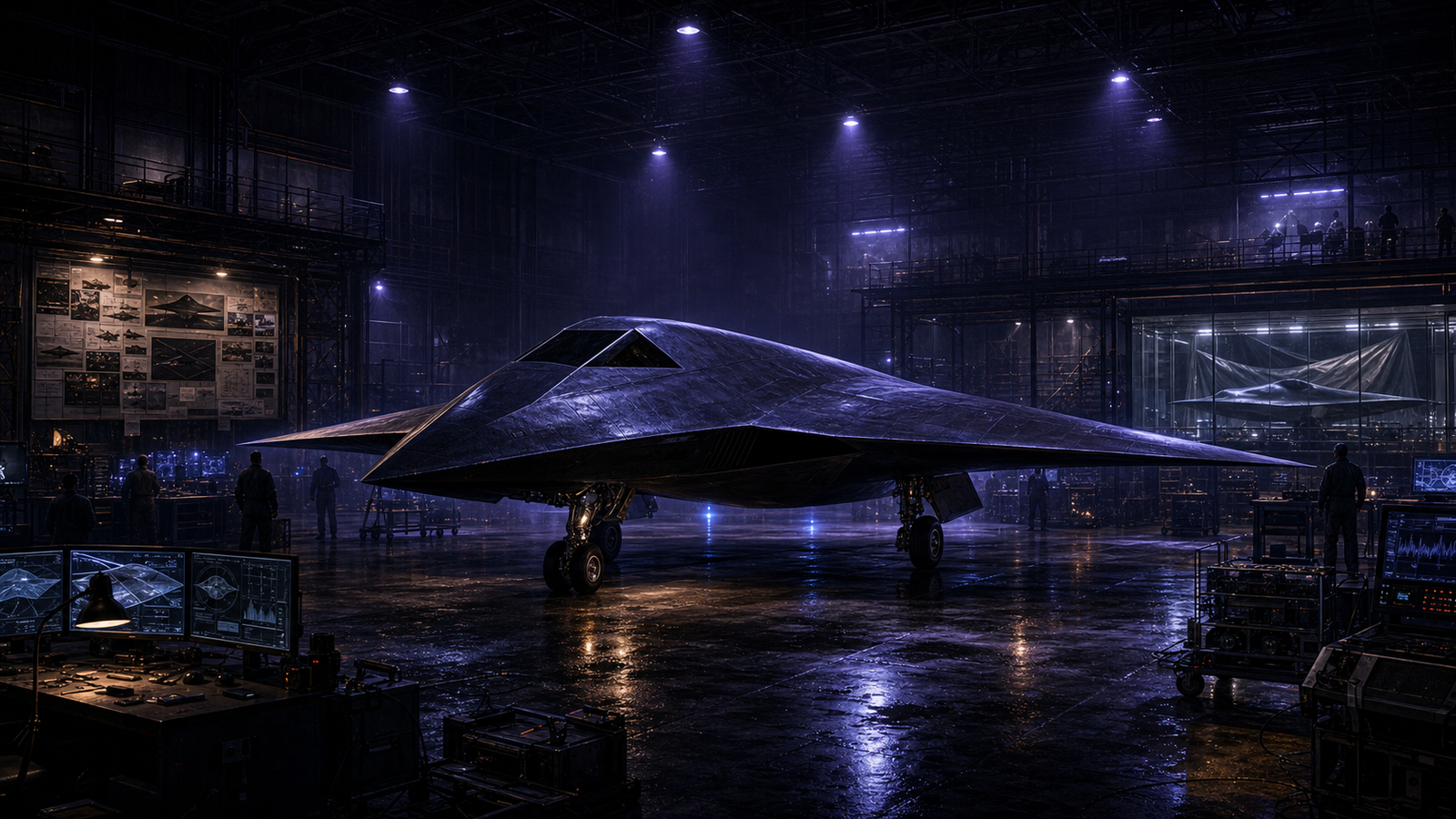
Bird of Prey Experimental Stealth Aircraft Program
Bird of Prey mattered because it proved a method.
That is the right place to start.
It was not important because it almost became the next operational fighter. It was important because it showed that a highly unconventional stealth aircraft could be:
- designed faster,
- built cheaper,
- and used to validate both low-observable shaping and new production ideas
without requiring the scale of a major bomber or tactical-aircraft procurement program.
That made Bird of Prey one of the most revealing black aircraft of its era.
The strongest public record supports a clear picture. This was a real Boeing stealth technology demonstrator, developed by Phantom Works, run from 1992 to 1999, first flown in fall 1996, and used across 38 test flights to validate low-observable techniques and rapid-prototyping/manufacturing methods. It was publicly unveiled in 2002 and later transferred to the National Museum of the U.S. Air Force.
What it did not become was an operational service aircraft.
What it did become was something else: a bridge between earlier stealth demonstrators and later Boeing design culture.
Quick profile
- Topic type: historical record
- Core subject: how Bird of Prey served as a stealth and rapid-prototyping technology demonstrator
- Main historical setting: 1992 to 1999 development and flight program, followed by 2002 public reveal and museum transfer
- Best interpretive lens: not “what fighter was Bird of Prey meant to become,” but “what design and manufacturing ideas did it prove”
- Main warning: Bird of Prey was historically important as a demonstrator, not as a hidden near-production combat aircraft
What this entry covers
This entry is the headline page for the Bird of Prey cluster in the black-projects archive.
It covers:
- why Boeing built the aircraft,
- why Phantom Works mattered,
- how the project balanced stealth with affordability,
- what the 38-flight campaign actually did,
- why features like gapless control surfaces and a shielded intake mattered,
- how manual controls and off-the-shelf parts fit the program,
- why the aircraft was revealed in 2002,
- and how it influenced later Boeing work.
That matters because Bird of Prey is often remembered only for its strange shape. Its deeper importance lies in what it proved about how stealth aircraft could be designed and built.
Not a fighter program, but a technology demonstrator
Bird of Prey is easiest to misunderstand when it is treated as a lost operational fighter.
That is not the strongest reading.
Boeing and the museum both describe it as a single-seat stealth technology demonstrator. The project existed to validate:
- low-observable concepts,
- advanced design techniques,
- and construction methods,
not to move directly into frontline service in its published form.
That matters because it changes how the whole aircraft should be interpreted. The Bird of Prey was a laboratory that flew. Its true output was knowledge.
Why Boeing built it this way
Bird of Prey mattered because Boeing chose to make it a small, internally funded, rapid prototype.
That is one of its most distinctive features.
The company said the aircraft was fully funded by Boeing and cost about $67 million. For a black aircraft program, that is a striking number because it signals a deliberate effort to control cost and cycle time while still testing serious low-observable ideas.
That matters because Bird of Prey was not only about stealth. It was also about whether advanced aerospace experimentation could be done more cheaply and more quickly than the public usually assumed.
The Phantom Works culture behind it
The program belongs to Boeing Phantom Works just as much as it belongs to the aircraft itself.
Phantom Works is Boeing's advanced research and development arm, built around exactly the kind of rapid experimentation that Bird of Prey represented. Boeing now explicitly points to Bird of Prey as an example of Phantom Works' rapid-prototyping culture.
That matters because the aircraft becomes easier to understand when seen as a Phantom Works product rather than only a stealth curiosity. It was the embodiment of a particular development philosophy: fast iteration, bold experimentation, and technology proof before full-scale production commitments.
The 1992 to 1999 black-project arc
The project ran from 1992 through 1999.
That timeline matters.
It places Bird of Prey in the post-F-117, post-Tacit Blue era, when stealth was no longer a shocking concept but still remained selective, expensive, and partly hidden. Bird of Prey belongs to the moment when stealth moved from proof of possibility to proof of process.
It was still a black project. But it was also a transition artifact: a sign that low observability was becoming something industry wanted to iterate more quickly.
First flight and the 38-flight campaign
Boeing states that Bird of Prey first flew in fall 1996 and completed 38 test flights. The museum repeats the same 38-flight total, and Air Force reporting from the 2003 museum transfer does as well.
That matters because the program was not a paper study. It was flown enough to validate real ideas.
In black-aircraft history, this is a meaningful threshold. A technology demonstrator that flies repeatedly under a closed test program becomes much more than a mock-up. It becomes a working argument.
What Bird of Prey was testing
The aircraft was used to test ways to make aircraft less observable both to radar and to the eye.
That matters because stealth is not only about one signature. The Bird of Prey was part of a broader low-observable design culture that treated:
- radar visibility,
- edge treatment,
- intake exposure,
- seam management,
- and overall shape
as integrated problems rather than separate fixes.
This is why its design remains so visually memorable. The shape reflects a logic of signature control, not conventional aesthetic balance.
Gapless control surfaces and the shielded intake
The museum fact sheet highlights two especially important features:
- gapless control surfaces blended smoothly into the wings to reduce radar visibility
- an engine intake completely shielded from the front
These matter because they represent the kind of details that often define whether stealth theory becomes stealth practice.
A stealth aircraft is rarely made or broken by broad shape alone. It is also made by how edges, openings, seams, and exposed internal components are handled. Bird of Prey was important precisely because it pushed those details in visible ways.
Why manual controls and off-the-shelf parts mattered
One of the most revealing things about Bird of Prey is that it was intentionally simplified in several areas.
The museum notes that its control system was all-manual with no computer assists, and that its landing gear was adapted from Beech King Air and Queen Air aircraft. Boeing also emphasized affordability and speed of production in the overall project approach.
That matters because the aircraft was not trying to be a polished frontline weapon. It was trying to get the right test article into the air without unnecessary cost.
This is one reason Bird of Prey is so historically instructive. It shows what engineers chose to simplify when the real target was stealth and process validation.
Large composite sections, disposable tooling, and virtual design
Boeing described Bird of Prey as one of its early uses of:
- large, single-piece composite structures
- low-cost, disposable tooling
- 3-D virtual reality design and assembly processes
The museum repeats these themes and treats them as central to the aircraft's legacy.
That matters because Bird of Prey was not merely testing shapes in the sky. It was testing how those shapes could be designed and built on the ground.
This is why the program belongs in the history of aerospace manufacturing as well as stealth. It helped prove that digital design and unconventional tooling approaches could meaningfully compress advanced-aircraft development.
Why the aircraft was revealed in 2002
Bird of Prey was publicly unveiled in 2002 because, in Boeing's explanation, the technologies and capabilities it had developed had become industry standards and no longer required concealment.
That is a fascinating point.
It means the reveal was itself evidence of success. The project could be acknowledged once its core lessons had already diffused into wider aerospace practice.
That matters because Bird of Prey was not declassified at the beginning of its relevance. It was declassified after much of its relevance had already been harvested.
The museum transfer and public afterlife
Boeing donated Bird of Prey to the museum in 2002, and Air Force reporting shows it joining the museum collection in July 2003.
That matters because museum placement changed the aircraft's public meaning. It stopped being only a hidden prototype and became a historical marker.
The museum setting also makes a larger argument: Bird of Prey belongs in the line of aircraft that mattered less for direct operational service than for what they changed in aerospace practice.
Why X-32 and X-45 matter to the story
The museum says Bird of Prey was revealed after its design techniques had become standard practice and specifically notes Boeing's use of those techniques in the X-32 demonstrators and later the X-45A unmanned combat air vehicle prototype. Boeing's 2002 release also drew a direct connection to the X-45A, noting that aspects of the UCAV's radar-evading design were developed from Bird of Prey experience.
That matters because it gives the demonstrator a visible lineage. Bird of Prey did not disappear into a dead end. Its lessons moved forward.
This is one of the strongest reasons the aircraft matters in your archive. It is a real bridge node between classic manned stealth experimentation and later Boeing unmanned and digitally driven design culture.
Why it never needed to become an operational aircraft
Bird of Prey sometimes gets described as a “lost stealth fighter,” but that misses the point.
Its historical importance does not depend on entering service.
In many black programs, the prototype is important because it almost became something else. Bird of Prey is important because it did exactly what it was supposed to do: prove low-observable concepts, validate build methods, and feed later designs.
That matters because it is a cleaner success story than many more famous advanced-aircraft efforts.
What the strongest public record actually supports
The strongest public record supports this narrower conclusion:
Bird of Prey was a real Boeing-funded stealth technology demonstrator developed by Phantom Works from 1992 through 1999. It first flew in fall 1996, completed 38 test flights, and was used to validate low-observable techniques and advanced design and construction methods, including gapless control surfaces, a front-shielded intake, large composite structures, virtual-reality-assisted design, and disposable tooling. It was publicly revealed in 2002 because those methods had become standard practice, and its legacy carried forward into later Boeing work, especially the X-32 and X-45. The record does not support treating it as a near-production operational fighter; its importance lies in what it proved as a demonstrator.
That is the right balance.
It preserves the aircraft's importance without turning it into something the public record does not show it was.
Why this belongs in the black-projects section
This page belongs in declassified / black-projects because Bird of Prey is one of the clearest examples of a real black aircraft whose significance becomes visible only after secrecy lifts.
It sits at the intersection of:
- stealth shaping,
- experimental aircraft design,
- prototype manufacturing innovation,
- and Boeing Phantom Works development culture.
That makes it a foundational page for the technology side of the archive.
Why it matters in this encyclopedia
This entry matters because Bird of Prey Experimental Stealth Aircraft Program explains how a small, one-off black aircraft can influence much larger futures.
It is not only:
- a Bird of Prey page,
- a Boeing page,
- or a stealth page.
It is also:
- a rapid-prototyping page,
- a manufacturing-methods page,
- a transition-from-secrecy page,
- and a bridge-to-later-systems page.
That makes it one of the most useful connective entries in the black-projects aircraft cluster.
Frequently asked questions
Was Bird of Prey a real aircraft?
Yes. It was a real Boeing stealth technology demonstrator developed by Phantom Works and later publicly revealed.
Was it intended to become an operational fighter?
The strongest public record does not frame it that way. It was a technology demonstrator designed to validate ideas, not a published near-service fighter program.
When did Bird of Prey first fly?
Boeing and the museum both say the first flight took place in fall 1996.
How many flights did it complete?
The public record from Boeing, the museum, and Air Force reporting says 38 flights.
Why is Bird of Prey important if only one was built?
Because it validated low-observable features and rapid-prototyping/manufacturing methods that influenced later Boeing programs.
What stealth features are most often highlighted publicly?
The museum especially highlights its gapless control surfaces and its engine intake shielded from frontal view.
Was Bird of Prey fly-by-wire?
No. The museum says its control system was all-manual with no computer assists.
Why was it revealed in 2002?
Boeing said the aircraft could be revealed once the technologies and capabilities it had developed had become standard practice.
What later aircraft did it influence?
Public Boeing and museum material point especially to later Boeing work such as the X-32 and X-45.
What is the strongest bottom line?
Bird of Prey mattered not because it nearly entered service, but because it proved that stealth experimentation and advanced aircraft manufacturing could be done faster, cheaper, and in ways that directly shaped later Boeing designs.
Related pages
- HAVE BLUE Stealth Demonstrator Black Project
- SENIOR TREND F-117 Stealth Fighter Black Program
- TACIT BLUE Low Observable Radar Aircraft Program
- BSAX Tacit Blue Stealth Surveillance Aircraft Program
- Advanced Technology Bomber B-2 Black Program
- TACIT RAINBOW Anti-Radar Stealth Missile Program
- DarkStar Stealth UAV Black Aircraft Program
- Sea Shadow Stealth Warship Black Program
- SENIOR CITIZEN Advanced Stealth Bomber Study
- Project OXCART A-12 CIA Mach 3 Reconnaissance Program
- Project GUSTO A-12 Successor Design Study
- Black Projects
Suggested internal linking anchors
- Bird of Prey experimental stealth aircraft program
- Boeing Bird of Prey history
- Phantom Works Bird of Prey stealth demonstrator
- Bird of Prey 1992 to 1999 program
- Bird of Prey rapid prototyping history
- Bird of Prey gapless control surfaces
- Bird of Prey X-32 X-45 influence
- Boeing stealth technology demonstrator history
References
- https://boeing.mediaroom.com/2002-10-18-Boeing-Unveils-Bird-of-Prey-Stealth-Technology-Demonstrator
- https://www.boeing.com/defense/phantom-works
- https://www.nationalmuseum.af.mil/Visit/Museum-Exhibits/Fact-Sheets/Display/Article/196041/boeing-bird-of-prey/
- https://www.af.mil/News/Article-Display/Article/138869/museum-welcomes-pioneering-technology/
- https://www.flightglobal.com/fixed-wing/2002/10/out-of-the-black-how-bird-of-prey-advanced-stealth/
- https://www.globalsecurity.org/military//library/news/2002/10/mil-021018-boeing01.htm
- https://athlonoutdoors.com/article/boeing-bird-of-prey/
- https://www.nationalmuseum.af.mil/Upcoming/Photos/igphoto/2000432218/
- https://www.nationalmuseum.af.mil/Visit/Museum-Exhibits/Fact-Sheets/?Page=36
- https://www.nationalmuseum.af.mil/Visit/Museum-Exhibits/Fact-Sheets/?Page=26&Search=www.instagram.com
- https://www.globalsecurity.orgwww.globalsecurity.org/military///systems//aircraft/bop-specs.htm
- https://www.theaviationist.com/2025/03/22/everything-we-know-boeing-f-47-ngad/
- https://www.nationalmuseum.af.mil/Upcoming/Photos/?igcategory=Museum+Aircraft&igpage=26&igsort=Title&igtag=Pearl+Harbor
- https://www.nationalmuseum.af.mil/Upcoming/Photos/?igcategory=Museum+Expansion&igpage=23&igsort=Title&igtag=Museum+Aircraft
Editorial note
This entry treats Bird of Prey as one of the most important “small” black aircraft in modern U.S. aerospace history.
That is the right way to read it.
Its public story is unusually clear. Boeing says the project ran from 1992 to 1999, cost about $67 million, and was fully funded by the company. The museum explains what made it historically significant: low-observable testing, gapless control surfaces, a front-shielded intake, manual controls, and new ways of designing and building aircraft quickly and cheaply. That combination is what makes Bird of Prey stand out. It was not a rumor aircraft, and it was not mainly important because of a lost operational future. It was important because it proved that stealth experimentation could be compressed into a disciplined, affordable, one-off demonstrator whose influence would show up later in real Boeing design culture. In that sense, Bird of Prey was less an endpoint than a hinge.